

‘Settlers’ Zionist perspective resembles the ideology that gave rise to Nazism’
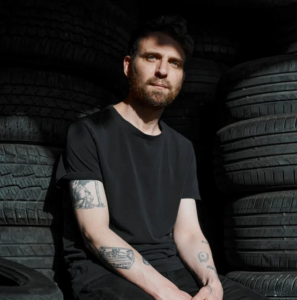
Guy Bernard Reichmann
Ofir Hovav reports in Haaretz on 5 March 2026:
Guy Bernard Reichmann was about 6 when his gaze interlocked with that of John Ivan Demjanjuk. For a long time he stared at the bemused face of the person who collaborated with the Nazis in World War II, now spread across the front page of the newspaper in front of him. The balding, beefy man, dressed in a uniform of the Israel Prison Service, stared back at him with a sort of grin, peering through thick glasses. The headline described this as the face of evil, but it mostly reminded Reichmann of his grandfather Marcel.
“I was too young to understand what the Holocaust was and who this man was,” Reichmann recalls now. “I didn’t understand why my family, of Holocaust survivors, so detested this pleasant fellow.”
His maternal grandmother and grandfather immigrated to Israel from Hungary: He succeeded in escaping before the Nazis occupied Hungary and launched the mass transport of the country’s Jews to Auschwitz; she survived that death camp. Marcel, Reichman’s paternal grandfather, finally managed to get to Israel from Romania after being incarcerated in a labor camp.
Reichmann: “He died quite young so I didn’t really have a chance to ask him about that, but when I saw that photograph in the newspaper, I started to take an interest. I tried to ask all kinds of questions, I wanted to understand who this Demjanjuk was and if he was connected with my family.”
Indeed, there are a few places where the stories of Ukrainian-born Demjanjuk and of Reichmann’s family overlap. “I remember seeing somewhere a map with all kinds of places marked on it where he worked, such as Sobibor and Treblinka, and I recognized them from my grandfather’s stories,” he says.
The places he recognized on the map were at the center of an episode that rocked Israel for seven years, after Demjanjuk was extradited there from the United States and accused of being the infamous “Ivan the Terrible” of the Treblinka death camp. The trial, which began in 1987 and concluded a year later, was the second such event in Israel – following the trial of Adolf Eichmann, in 1961 – in which a death sentence was handed down under the Nazis and Nazi Collaborators (Punishment) Law of 1950. However, in 1993, the Supreme Court ruled, on appeal, that Demjanjuk’s identity as “Ivan the Terrible” was in doubt and acquitted him.
Shortly after the acquittal, as it happened, Reichmann’s family moved from Petah Tikva to the town of Pardesiya in central Israel. Reichmann, who is today 42, was in fifth grade at the time. Now, from the perspective of time, it seems to him that he was maybe too deeply immersed in the whole Holocaust thing.
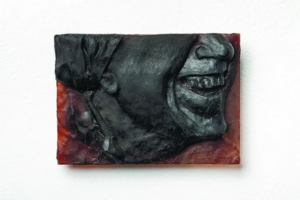
‘A Truth Teller’, a bas-relief depicting Minister Orit Strock, from Reichmann’s series ‘Ascent of a Smile’, 2025, featured in the Defragmentation exhibition at the Rosenfeld Gallery in Tel Aviv
“Maybe it was a bit over the top for a kid of that age. There was a period when I couldn’t sleep at night because I had terrible nightmares,” which, he says, reflected both his state of mind internally and with respect to external events: Everyone seemed to be preoccupied at the time with Demjanjuk, Eichmann and the Nazis.
“There was a lot of talk about his identity,” he notes, “and in our family there was also a thing about changing names. When Grandpa Viktor came to Israel he changed his name to Yitzhak. Grandma Edith was called Esther here.”
On Reichmann’s first day at the Hanoar Haoved Vehalomed youth movement in Pardesiya, he was given a name tag that read: “Guy Eichmann.” “Maybe it was a bit funny” at the time, Reichmann says now, but adds that it took him years to realize that. He stuffed those memories – of the name tag, Demjanjuk’s face, the nightmares – into a folder in the far reaches of his consciousness, figuring he would get back to it at some point.
Minor fractures
Reichmann’s work on “Defragmentation” – his current, and excellent, exhibition, at the Rosenfeld Gallery in Tel Aviv (curator: Maya Frenkel Tene) – enabled him to do just that. The show, which opened a month ago (and was supposed to run until March 21, but as of this writing was temporarily closed because of the war), features two separate bodies of work that conduct a sort of dialogue in the mind of the viewer.
One is a series of bas-reliefs of what turn out to be the smiles on the faces of settlers and the hard-right politicians who support them. The other is a group of miniature paintings based on images from the Demjanjuk trial, in which Reichmann interweaves his personal and family biography with the historical and political memory of that period.
The little paintings are quite spaced out, essentially swallowed up by the walls in the gallery space, which seems to be almost empty. The paintings compel the viewer to move close and bend over in order to look at them and dwell on the scenes depicted: among others, Demjanjuk talking to his guards, smiling, wandering about in what looks like the prison yard.
Alongside these works are some everyday scenes – a random conversation in the kitchen; a boy who diverts his gaze momentarily from a computer screen and looks at the viewer – along with some grotesque images plucked from the artist’s childhood nightmares. The miniature format evokes the experience of flipping through a family photo album. Private and public fuse into a vague emulsion of discontinuous memories on a confused time axis.
“You know how you remember something that, like, happened to you yesterday, but on the other hand you can’t really place it along some sort of timeline? Well, those things are like little fractured pieces organized in my head,” Reichmann explains. “That’s part of the idea: to try to create these kinds of small worlds, with spaces between them, so the viewer can choose to enter a different world each time.”
The miniature format also satisfies one’s voyeuristic instinct, by means of a sort of uncontrolled rummaging through Reichmann’s memories, as well as through general Israeli memory. At the same time, the small scale of the works creates a feeling of control that facilitates the processing of events. Besides that, Reichmann explains, “My hands tremble a bit, and I wanted to challenge myself a little: to choose watercolors and gouache. To create, actually, some sort of stability.”
In the center of one of the works, serving to link the small paintings with the bas-reliefs of the settlers’ smiles, is an intimate interpretation of the cover of an iconic Israeli children’s book called “Hanna’s Sabbath Dress: An Israeli Folktale,” by Itzhak Schweiger-Dmi’el.
This tiny bas-relief features a bespectacled moon, a likeness of Demjanjuk, with an elusive smile, possibly reflecting a feeling of Schadenfreude. Hanna’s place is taken by a little boy, the likeness of the artist, who holds his stained shirt up to the moon. A caption reads: “And look! The stains disappeared, are gone … And in their place, light…!”
“It’s a pretty weird story,” Reichmann observes. “Like, why is helping another person supposed to leave stains on her at all? But then comes the moon, this deus ex machina, that cleanses her. I think there is something in this story of the Demjanjuk trial, which purified us as a society, cleansed us.
“I’m not taking sides as to whether he was guilty or not,” he continues. “Within this huge Nazi machine he’s a cog that I don’t care about at that level. What I am talking about is the purifying effect it [his trial] had on us, as a society. That whole operation of ours, as a society – the fact that we exonerated a symbol of the biggest crime ever committed against us, because we are a law-abiding society that has a strong judiciary and is not a society that only seeks revenge – I think that operation purified us. I can perhaps also say that it’s not a surprise that this happened close to the Oslo Accords, close to the fall of the Soviet Union, within this sort of wave that characterized that period.”
How do you think that trial would end today? “Today Demjanjuk would not be acquitted, probably, or he would be given a position in Likud or something,” he says with a laugh.
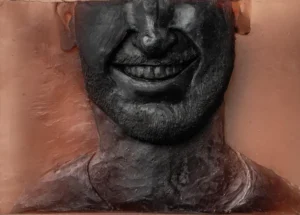
A Rising Zealot,” 2025
Institutionalized violence
Juxtaposed with the artist’s personal-public-nightmarish album of images, in which Demjanjuk’s enigmatic smile plays a starring role, Reichmann positions bas-reliefs of smiles of settlers that he gleaned from video footage documenting attacks they carried out against Palestinians. If in the miniature paintings the smile is a sort of ambiguous sign, connecting personal memory and national narrative, in the bas-reliefs it assumes documentary validity.
“I went obsessively through hundreds of clips of settlers who documented themselves attacking Palestinians,” Reichmann relates.
At first he sought to replicate the graphic composition of classic paintings from art history, but as more images accumulated, he realized that what he was painting most were the smiles of the settlers in the footage.
Reichmann: “I understood that there is something very intense about all this. A smile is not something fixed. It symbolizes a sort of situation in flux. A lot of things can come after a smile: mockery, laughter, something more violent like [someone saying], ‘Ya son of a bitch, we’ll burn your village.’ In my perception, a smile possesses this ability to shift between situations of happiness, embarrassment, mockery or threat, and that’s a situation that in my view attests to [a feeling of] sovereignty among those holding power. Traditionally, the ability to express something is reserved to rulers, to kings, who are entitled to do whatever they want. The oppressed have no such right. Their emotional and expressive range is very limited.”
Indeed, he adds, “The oppressed doesn’t have the privilege to smile. We are not capable of perceiving them as beings who can feel anything more complex than, say, an expression of sorrow. That was very blatant now in the war, in photographs of hungry children in Gaza, for example, with people saying that, ‘They don’t have the face of a person who suffers.'”
Reichmann chose to document smiles of relatively prominent figures among the settler right. Among them are Yinon Levi, who was caught on film shooting Palestinian activist Awdah Hathaleen to death in the West Bank village of Umm al-Kheir in July 2025; he is due to be tried, subject to a hearing, on a charge of negligent homicide. Maximum punishment for that offense is 12 years in prison, “but he’ll probably get one year, if at all,” Reichmann avers.
The familiar, smug smile of Settlement and National Missions Minister Orit Strock appears on another bas-relief. “There is the violence that exists on the ground, but Strock represents institutionalized violence,” the artist declares. “Her remark about this being a ‘period of a miracle,’ and the fact that even on October 7 she came out and said, ‘First of all, happy holiday’ [referring to Simhat Torah, which fell that day] – those, for me, are acts of violence.
“That is,” he continues, “you first say ‘Happy holiday to all the Jews here in the room,’ and everyone else is of secondary importance. The whole emotional range of anxiety, panic, fright, hatred, anger, confusion, horror – everything we felt in the wake of October 7 – is less relevant than the fact that we are first of all happy. We first of all smile and greet each other with ‘Happy holiday.’
“It’s some sort of attempt to take this awful thing that happened to us now and make it part of the great myth of the Jewish people. Like there’s the myth of the splitting of the Red Sea, like the story of the Haggadah on Passover. So October 7 is also an element in this myth of ours, of redemption. So in that sense: ‘First of all, happy holiday.’ The thought of hope was taken from us and replaced with anticipation of the redemption. That’s what’s dominant today in this country’s emotional discourse.”
Reichmann draws a connection between the Jewish settler-pogromists and the Demjanjuk trial in another sense: “The reason Demjanjuk was acquitted is that the court entertained the slightest doubt that maybe he is not that terrible person, that it’s not really the same face, that maybe it’s not exactly the same name and maybe we should not rely on these specific documents.
“That doubt,” he goes on, “led the court to free a person who, with high probability, was a Nazi criminal – while today we have all the faces of these people who are attacking, throwing stones, murdering. It’s there. There’s no doubt about that, but they are walking about totally free. The situation goes beyond the judiciary or the institutional elements that validate such crimes; it’s our demand, as a society, for justice, that is disappearing. We don’t expect justice to be served equally between people.”
Asked whether his exhibition aims to draw a direct line between settlers and Nazis, Reichmann balks. “We haven’t yet sent anyone to gas chambers or things like that,” he scoffs, “so it’s not really possible to compare. But why place the bar at the highest level, of the Nazis? It can be placed lower down: In fascist Italy, for example, from which we are not so very different.
“What interests me most is ideology,” he says. “I do see a resemblance between the ideology, or the Zionist perspective, as it’s maintained by the settlers, and ideological streams that gave rise to fascism and Nazism. At the ideological level, one can identify concepts including supremacy, living space and justification for violence. In that sense, there is almost a checklist here of attributes that are familiar from fascist regimes.”
At the same time, he adds, “I do not judge a society on the basis of ideology alone, but on a basis of actions. Clearly we’re not talking about the same scale, nor is that what I am arguing here. What I can say is that the threshold at which ideology is translated into violence can be far lower than the eroded use of Nazism as a basis for comparison.”
Overall, Reichmann suggests, “It’s too easy to pull out the ‘Nazi’ card, because that way it’s easier not to cope. It’s a way to end the discussion. If you’re a Nazi, there’s nothing for me to talk to you about, and I can go on burying my head in the sand. This is not something that’s on the ideological fringes and it’s impossible to ignore it, because that’s what’s happening here. Both those who reject that violence and those who are appalled by it are still not necessarily calling it into question.”
A sense of ownership
The focus on relations of power and on the way men conduct negotiations associated with them, as seen in the exhibition, is not disconnected from Reichmann’s broader body of work. Over the years he has frequently examined the way masculinity is shaped through violence, fraternal ties and relations of dominance.
Frequently he does so by means of a preoccupation with images from fringe culture, fantasy or war games. In previous exhibitions – such as “Chansons de Geste” (“Songs of Heroic Deeds”), presented at the Tel Aviv Artists Studios in 2022 (curators: Yoav Weinfeld and Omer Sheizaf); in “What’s Up, Man?” at the Center for Digital Art, Holon, in 2023 (curator: Meir Tati); and additional works showcased at the Rosenfeld Gallery and Tel Aviv’s Nahum Gutman Museum of Art – he focused on images of aggressive masculinity (i.e., punks, soldier-warriors and skinheads, among others), but counterpoised with fragility.
This isn’t the first time Reichmann – who has a B.A. in history and literature from Tel Aviv University, and an M.F.A. from Jerusalem’s Bezalel Academy of Arts and Design – has examined power relations and domination through the prism of settlers. Along those lines, the work “Dishabituation: Do you know where your children are?” which Reichmann presented at the Nahum Gutman Museum (curator: Tali Kayam), as part of the 2000 exhibition “Staycation,” was a continuation of the graduation project he presented at Bezalel in 2018. Underlying it is an attempt to capture Israel’s violence in the territories and to link it to the maturation experience of Israeli children. To that end, the artist created a strategic board game replete with colorful, fantastical and violent images and objects.
“There was a lot of ridiculing of the settlers there,” he explains. “I wanted to show the destruction and the post-apocalyptic world of the settlers, and also to ridicule them. In time, I realized that it wasn’t working and that it was even serving their purpose. To ridicule someone, to make a caricature of them, makes the medicine go down. It looks a lot less threatening. What’s said is not taken seriously. In the end, it serves their ideology.”
In his new bas-reliefs, he has avoided ridicule. “I wanted to present things as they are,” he says. “Not to cover them up. I wanted the viewer to feel the ridicule they feel toward him, not the ridicule directed from me toward them. It’s the same mouth that shouts and spits and curses and also smiles, because he’s the master. Because he can do whatever he wants.”
The series of new works focusing on settler violence is also related to the artist’s general attitude toward his homeland. Since December 2024 he’s lived in Paris with his partner, Chaya Hazan, director of the Paris branch of the Tel Aviv-based Dvir Gallery. That distance has enabled him, he says, to observe anew the place he came from and the conditions that enabled him to move about unhampered within it.
Reichmann: “At some point I understood that I was walking around Israel like the lord and master. I’m a man, a Jew, living in Tel Aviv. The light is turned on for me, the doors are opened for me – no one stops me. The police let me proceed. There’s a feeling that the territory belongs to you.”
That feeling of ownership, he notes, “involves something very masculine. I know very few women who walk about in the world with that kind of lady-and-master feeling.”
The move to France was in part an attempt to get away from that feeling. “One of the reasons I moved was that I didn’t want to be lord and master anymore. I was fed up with that. I’m trying to disconnect from that, to feel less comfortable, [a feeling brought about] only by virtue of the conditions into which I was born.”
In previous years, Reichmann frequently addressed issues concerning the LGBTQ community; indeed, he was presented as a relatively prominent voice in it. Today he avoids political categorization via his sexual identity. “I don’t feel I am the spokesperson for anyone,” he declares. “There are contradictions within me. There are conservative elements and liberal elements. I’m not looking to fit into some sort of rubric.”
Reichmann draws a connection between the feeling of ownership he felt in Israel and the way masculinity in the country is in general shaped via power relations. “When a man feels that ownership has been taken away from him, he feels he has nothing,” he says. “In a society in which masculinity is connected to ownership and domination, the loss of domination is experienced as a loss of identity. And then blame is directed at those weaker than you.”
In this sense, he sees the imagery of the works in the new show as the expression of something greater: “The ability to stand opposite the camera and smile at a moment like this is a declaration of ownership: of the territory, of the situation, of the person behind the camera – whether Palestinian or ‘sourpuss leftist'” – referring to a term used by Netanyahu to describe his political opponents.
As a “sourpuss leftist” himself, who moved to Paris against the background of the war in Gaza, Reichmann is nevertheless not in a hurry to declare that he’s made a clean break with Israel. On the contrary: The distance only underscores the local structure in which he grew up. Despite disgust with politics and the growing alienation between the world of culture and the general public, he continues to look inward, to the place where the light is automatically turned on.
“The fact that I moved away doesn’t mean I can’t create something stemming from my sense of belonging to here. There is something so unique about this place, which is so full of contradictions and conflicts, and there is something in art that makes it possible to touch it and talk about it and try to heal it. I know that is the reason I’m engaged with it. It’s what makes it possible for me to talk about the internal contradictions and the ideologies that I harbor inside me. These are questions I don’t succeed in resolving in any other way.”
Reichmann had planned to mount his new exhibition in both Tel Aviv and Paris, but in the meantime the war Israel is currently embroiled in has kept him here. His return flight to Paris was canceled, and the gallery closed.
“During the Gaza war I wasn’t in Israel, and the worry from abroad was insane,” he relates. “That was one of the most difficult periods I’ve ever experienced. It probably took five years off my life. Ultimately, my family and friends are here, I’m not isolated. I haven’t given up my passport, I pay National Insurance. It’s not that I have renounced my citizenship, so I was insanely uneasy. Consumed by worry. Now I’m here and it’s of course not pleasant, but it’s a different kind of fear.”
Together with conveying his natural concern, Reichmann also cites the moral dilemma he’s grappling with at present. “I’m quite shocked by this hooliganism of attacking another country. Israel is conducting itself in the world now as though it’s a bit bigger than it really is. It’s a sort of petty hooligan that gets backing from the powerful United States and allows itself to act without inhibition.”
This article is reproduced in its entirety