

The Palestinians stuck in the no-man’s-land of Jerusalem and the Israeli settlement plan to expel them
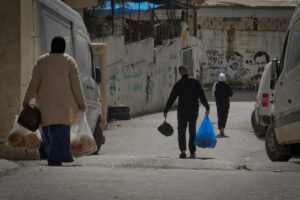
Qalandia refugee camp, February 2026
Qassam Muaddi reports in Mondoweiss on 19 February 2026:
The entrance to Qalandia refugee camp is quiet and nearly empty of people on a late Friday morning. Located just north of Jerusalem, the camp announces itself with the blue iron fence of a UN Relief and Works Agency school and a series of painted murals along its outer walls. A few dozen meters past the entrance, the stillness gives way to the low bustle of daily life. For seven decades, this corner of Palestine has welcomed visitors in a perpetual state of suspension, neither fully settled nor in motion.
Vendors have turned a side of the street into a popular market, selling vegetables, fruit, and home accessories. Deeper in, men, women, and children form queues outside local food vendors waiting for their plate of hummus or bag of falafel. Others walk back home in the narrow side streets and alleyways carrying bags of groceries. Children stop along the path to play as older men stand in front of the large mosque door, chatting as they wait for the start of the weekly prayer.
It is hard to detect, but underneath the seemingly normal routine, there’s a palpable sense of anguish. The unease is shaped by years of accumulated collective trauma for a community perpetually in the crosshairs of Israeli settlement expansion, its future uncertain, its residents still absorbing the shock of the most recent military campaign.
In late December 2025, the Israeli army launched a wide-scale demolition campaign in Qalandia refugee camp and the neighboring town of Kufr Aqab, destroying dozens of Palestinian businesses and structures. A month later, in late January 2026, the campaign resumed, claiming even more structures.
The objective of the operations was to clear an entire area adjacent to the Israeli separation wall of the presence of any Palestinians. Dubbed “Operation Capital’s Shield” by the Israeli army, it was the largest incursion into the area in years. The Israeli army described it as a “law enforcement” operation targeting structures built near the wall that allegedly allowed Palestinians to cross illegally into Jerusalem. But Palestinians see these operations as part of a broader effort to separate Palestinian communities in Jerusalem’s periphery from the city itself, and to consolidate new Israeli settlements between Jerusalem and its Palestinian hinterland to the north.
Established in 1949, Qalandia refugee camp was named after the Palestinian town of the same name, which is today separated from the camp by the apartheid wall. The camp is confined to a tiny urban expanse directly adjacent to the larger town of Kufr Aqab, itself akin to a dense forest of residential towers straddling both sides of “Al-Quds Street,” which connects Jerusalem to Ramallah.