

The Israeli right is marching under a new flag
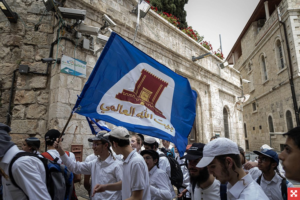
A participant in the Jerusalem Day Flag march carries a flag bearing the image of the Temple Mount, in Jerusalem’s Old City, 14 May 2026
Menachem Klein writes in +972 on 15 June 2026:
Among the familiar sea of Israeli flags at the Jerusalem Day Flag March last month, another symbol caught my eye: a light-blue banner bearing the image of the Temple Mount, known to Muslims as the Al-Aqsa Mosque compound or Al-Haram Al-Sharif. It appeared again and again among the roughly 70,000 young religious-nationalist men and women who took part in the annual procession celebrating Israel’s conquest of the city in 1967.
For Jerusalemites like myself, that symbol is nothing new. It is plastered throughout the city — on cars, signposts, and bus stops — often accompanied by the slogan: “We face the Temple.” A few months ago, I even came across a photograph of the same icon on a mock road sign along a major West Bank highway directing travelers toward Jerusalem, one of dozens placed by Temple activists across the country.
Yet the proliferation of the symbol at this year’s march reflects the growing mainstreaming of the Temple Mount movement within Israel’s religious-nationalist camp. To understand this convergence, it is worth recalling how the Flag March came to stand at the center of the national-religious experience of an entire generation of Israelis.
Although the first procession took place in 1968, soon after Israel’s illegal occupation of the West Bank, Gaza Strip, Golan Heights, and East Jerusalem began, for decades it remained a relatively peripheral event within the religious-Zionist sector. In the early 2000s, however, a new dimension of the march became central to public discourse around it: violent attacks on Palestinians and their property in Jerusalem’s Old City.
That violence, which has only grown over time, unfolded within a broader political context. The Camp David summit of July 2000 collapsed in part over disputes around sovereignty in Jerusalem and the future of the Temple Mount — namely Israeli demands for a Jewish prayer area at the site and continued Israeli sovereignty over parts of East Jerusalem.