

Stop treating the mass killing in Gaza as a series of IDF ‘exceptions’ – it’s the rule
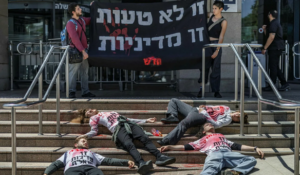
Activists from the Hadash party hold a sign reading ‘It’s not a mistake, it’s policy’ in protest of Israel’s policies in Gaza and the West Bank in Tel Aviv, August 2026
Yagil Levy writes in Haaretz on 24 August 2026:
The responses of Haaretz journalists to the killings in Gaza are courageous, but they also reveal a key limitation in the type of criticism leveled at the military’s conduct. Nir Hasson criticized the army’s announcement that there’s no justification for investigating three widely covered incidents that occurred during the Gaza war, the most famous of which was the killing of the seven World Central Kitchen workers.
Hasson presents the scale of the killing throughout the war and concludes: “The Israel Defense Forces isn’t really interested in seeking the truth, imposing discipline on its soldiers, or complying with the laws of war under Israeli and international law.” Gideon Levy suggests returning the discussion to the existence of genocide in Gaza, which receives a seal of approval in Israel simply by categorizing all Gazans as affiliated with Hamas. If so, where’s the problem?
There’s no point in being satisfied with the demand that the military investigate how more than 20,000 children and 10,000 women were killed, as if this were a collection of isolated exceptions. The central question is not who deviated from orders, but what policy created this outcome. The military acted according to an organized policy that set new thresholds for permissible civilian harm (“collateral damage”) – up to 20 civilians in an attack on a Hamas activist, and even over 100 civilians in an attack on a senior Hamas official. Policy does not require an investigation by, the Military Police Criminal Investigation Division.
Similarly, the public declaration by the Israel Air Force chief at the beginning of the war that the early warning policy saving civilian lives (“roof knocking” i.e. small missile strikes to notify civilians of larger impending missile strikes) was irrelevant in a war – doesn’t require an investigation, as no higher-ranking official contradicted it.
Even the decision reported by Yaniv Kubovich, to establish “kill zones” – in which any man entering, even a civilian, is considered a legitimate target for killing – doesn’t require an investigation. It stemmed from a clear policy incorporating the prevailing assumption that there are no innocents in Gaza, thereby also sparing soldiers the risk involved in a more cautious policy. Several of the high-profile incidents examined by the military were the result of this approach.
A Military Police criminal investigation cannot examine policy. Moreover, it may even reinforce the legitimacy of exercising violence, especially when the investigation is efficient and leads to the punishment of those responsible. It enables the army to present itself as an organization that supervises its own functioning and corrects its failures, and it even creates a clear distinction between exceptions and routine conduct.
After all, Military Advocate General Yifat Tomer-Yerushalmi tried to single out the behavior of the Sde Teiman Force 100 members as an exception, thereby normalizing the routine abuse of Hamas detainees. (Some members of Force 100, a Military Police reserve unit, were accused of severely abusing and sexually assaulting a Palestinian detainee at the Sde Teiman base.)
At the same time, preoccupation with genocide drags the debate into the question of whether the conditions for defining the war as genocide have been met – chief among them the intent to destroy a group, which is difficult to prove. Thus criticism becomes trapped in a legal dispute, creating the impression that if genocide has not been proven, the policy of killing is in the realm of the permissible.
Yet the moral and political judgment of the policy doesn’t depend on a legal ruling. Absurd as it may sound, the very accusation that Israel is committing genocide is a gift to anyone seeking to prevent discussion of what’s happening in Gaza.
Conventional criticism of the killing therefore fluctuates between two extremes: at one end, a criminal “exception,” and at the other, genocide. Both are frameworks that organize the violence in a way that makes it easier for the public to identify and judge. Between them, the policy itself disappears. As long as policy is not at the center of the discussion, even the harshest criticism of the killing is liable to help legitimize it.
This article is reproduced in its entirety