

Political pressure on IDF High Command hampers enforcement against settler violence,
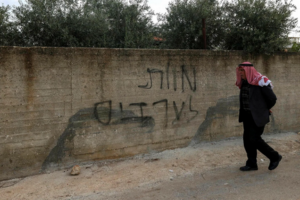
A Palestinian man walks past Hebrew graffiti that reads ‘Death to Arabs’ on the wall of a home damaged house in a reported attack by Israeli settlers in the village of Deir al-Hatab, near Nablus in the West Bank, March 2026
Yaniv Kubovich reports in Haaretz on 31 March 2026:
IDF sources say that political pressure is preventing the army’s senior command from addressing settler violence against Palestinians in the West Bank, and that the rapid spread of illegal outposts, often without coordination with the army, has both direct and indirect backing from the political echelon and religious figures.
The defense establishment warns that IDF forces are dealing with a new security reality that creates an unusual burden on them and leads to a constant increase in violent incidents with Palestinians, or even between settlers and the army. The result is the attrition of forces in the West Bank and a diversion of troops and resources from other fronts. Furthermore, senior security sources warn of a rapid spread of agricultural settlements and illegal outposts, with about 120 illegal farms and outposts currently running and dozens more expected to be established in the near future.
Every establishment of a new farm or outpost becomes a flashpoint requiring the deployment of forces, and soldiers are required to operate in situations for which they were not trained, involving friction between settlers and Palestinians, and in many cases, also between settlers and the army. Some of the incidents, security officials explain, are carried out by armed settlers and sometimes involve soldiers in active duty or reservists who reside in these outposts and carry IDF weapons.
The army admits that in many cases, shooting in violent incidents against Palestinians is done with official military weapons, a phenomenon that complicates enforcement and undermines the boundaries of authority. According to army officials, the political echelon has made decisions in recent years that put the IDF in impossible situations, where it is both required to protect the farms and outposts while mitigating security implications.
A security official familiar with the situation in the West Bank describes a complex reality in which, he says, “there is constant pressure from rabbis and right-wing [political] figures on the senior command not to act against these soldiers. Everyone understands who can be touched and who cannot.”
According to security officials, Knesset members, ministers and leading rabbis who condemn the violence on one hand also come to affix a mezuzah and hold a ceremony at every settler farm established in the area. These Knesset members and ministers tend to visit these farms and outposts without informing the army, which further increases tension on the ground.
The security official added that certain units of settler-soldiers, often termed “regional defense” units, are perceived as particularly untouchable. The feeling described by officers and soldiers is one of confusion and a lack of understanding of the role of the IDF. They say that the lack of a clear policy creates a reality where forces often find themselves in confrontation with violent settlers, which undermines their authority on the ground and often makes them targets of settler violence.
The tension between the military and settler leadership is also reflected in public statements. In a recent lesson delivered by Rabbi Eliakim Levanon at the Avinoam settler yeshiva in the West Bank, he described a conversation with Central Command chief Maj. Gen. Avi Bluth, in which he claimed that IDF orders to evacuate Jewish settlements have no force of law.
“An evacuation order has no meaning,” Levanon said, adding that Bluth “laughed” when asked about enforcing the orders. According to Levanon, Bluth said in their conversation that as long as no explicit order is given by him, no actual evacuation would take place.
Levanon further claimed that Bluth was “completely one of us” and that there is direct and ongoing dialogue between the senior command and the settlement leadership. He further claimed that options for establishing new settlements were offered by Bluth himself. The IDF Spokesperson’s Unit confirmed that a conversation indeed took place between Bluth and Levanon but denied the rabbi’s statements, claiming that the conversation was aimed at “discussing ways to prevent violence and that “there was no discussion about future construction planning.”
IDF sources say there is currently no strategy for managing the phenomenon of settler violence, and the de facto policy stems from political constraints and does not result in an adequate security response on the ground to the implications of settler violence. Within the army, there is also sharp criticism of the senior command, whose official responses are perceived as weak and detached from the severity of the situation.
A Palestinian house torched by Israeli settlers in Jenin, last week. Credit: Mohamad Torokman/Reuters
Commanders on the ground warn that Chief of Staff Eyal Zamir is not aware of the depth and scope of the phenomenon, and similar criticism is heard against Bluth, who, according to sources familiar with the situation, is not sufficiently dealing with the phenomenon and has not set clear lines for enforcement.
IDF sources also warn that continued disregard for the uptick in violence could lead to a severe security escalation, and that the pace and scope of incidents could, within months, become an unprecedented wave of nationalist crime. The army identifies another worrying phenomenon: the establishment of local defense squads in Palestinian villages, designed to deal with settler attacks. The IDF fears that the involvement of these forces in violent incidents could lead to a broad escalation.
Meanwhile, the IDF emphasizes that, contrary to statements by senior ministers, security coordination with the Palestinian Authority continues and is even considered close. Security officials note that Palestinian security mechanisms are working resolutely to maintain stability and are even actively fighting Hamas. However, they claim that the political echelon ignores these efforts and does not give the Palestinian Authority security forces influence on the ground.
Meanwhile, legally, IDF commanders on the ground are described as helpless. Military Advocate General, Maj. Gen. Itay Offir does not support arrests, investigations, or indictments against settlers who commit violence, even when they are reservists in active military duty and when offenses are committed with IDF weapons.
In his view, this is enforcement within the jurisdiction of the Israel Police. However, the police do not provide any enforcement, even when there are documented cases of severe violence by soldiers or reservists.
No criminal proceedings are initiated following such incidents, though sometimes limited command measures, such as temporary suspension from duty, are taken.
In practice, therefore, the IDF condemns incidents of violence by Jews in the West Bank, but enforcement remains limited and sometimes almost nonexistent. The result is a widening gap between the senior command’s declarations and operational steps on the ground, especially when it comes to reservists or forces identified with the settlement movement who actively participate in violent incidents against Palestinians.
After an attack by IDF soldiers on a team of CNN journalists last week, Central Command chief Bluth condemned the incident, and an investigation determined that “several failures were found in the soldiers’ conduct,” alongside “deficiencies in behavioral norms and deviation from IDF orders.”
Chief of Staff Eyal Zamir determined that it was “a severe ethical and professional failure.” However, despite the severity of the incident, the only consequence was suspending the operational deployment of the Netzah Yehuda reserve battalion, without taking legal action against the soldiers, except for one who was dismissed. This battalion remains in active reserve service until today, and management of the incident apparently focused on “strengthening norms.”
This article is reproduced in its entirety