

Palestinian technocratic committee says it is ready to govern Gaza after UN approval, IDF withdrawal
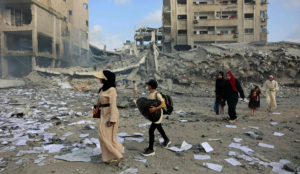
Palestinians walk past destroyed buildings following an Israeli strike in Gaza City on 24 July 2026
Liza Rozovsky reports in Haaretz on 27 July 2026
The Palestinian technocratic committee designated to administer Gaza under U.S. President Donald Trump’s postwar plan said Monday it is ready to assume authority over the Strip only after Israeli troops withdraw, appearing to contradict Israeli officials’ insistence that the plan’s initial phase would not require an IDF withdrawal.
The statement came a day after Israel’s security cabinet approved the initial deployment of an international stabilization force into a limited area of Rafah as part of the Trump-backed plan, ahead of Prime Minister Benjamin Netanyahu’s visit to Washington.
According to sources familiar with the cabinet decision, the force will enter a small area of Rafah in a gradual and limited capacity. A source in the Board of Peace told Haaretz that members of the National Committee for the Administration of Gaza would not enter the Strip at this stage. National Security Minister Itamar Ben-Gvir voted against the decision.
But in its statement Sunday, the committee said it had completed the institutional and operational preparations needed to assume responsibility for Gaza and would take over “as soon as the Board of Peace and the UN Security Council approve the deployment of the forces, and when the Israeli army withdraws.”
It was the first time the committee publicly identified both UN Security Council approval and an Israeli military withdrawal as prerequisites for assuming its mandate.
The announcement appears to differ from recent briefings by Prime Minister Benjamin Netanyahu’s office and officials involved in the Board of Peace, who have maintained that the initial pilot zones and deployment of international forces would not require an Israeli military withdrawal.
The technocratic committee is expected to operate in the “Orange Zone” – a small area situated between the Israeli Defense Forces’ Yellow Line, delineating where Israeli-controlled Gaza begins, and the Orange Line, which was unilaterally established by the IDF deep inside the territory officially under Hamas control.
According to another source familiar with the cabinet decision, Israel also approved the construction of two temporary residential zones in Gaza.
The committee also announced that its chairman, Ali Shaath, and members Bashir al-Rais and Adnan Abu Warda met Sunday in Cairo with a Belgian delegation following the Palestine Donors Group conference in Brussels two weeks ago. According to the statement, the committee presented Gaza’s reconstruction plan, including funding needs estimated at $30 billion over the first two years, along with the governance, transparency and accountability mechanisms on which international support for the project is based.
Earlier this month, Hamas announced that the body administering Gaza on its behalf had resigned in preparation for transferring its powers to the technocratic committee. Israel, however, has so far refused to allow the committee’s members, who are based in Cairo, to enter the Strip.
Haaretz previously reported that the Trump-backed Board of Peace intends to begin implementing its postwar Gaza plan in areas deemed “free of terrorism,” transferring civilian governance to the technocratic committee while an international stabilization force assumes responsibility for security.
The framework presented by the board envisions Israeli troops withdrawing from areas transferred to the international force, even before Hamas completes its disarmament – a provision that Israeli officials have been expected to oppose.
This article is reproduced in its entirety