

Palestine Action case reveals the limits of terrorism discourse
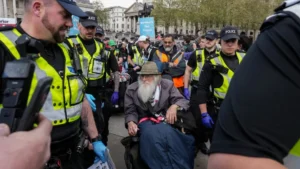
An elderly man in a wheelchair is escorted away by police as protesters gather in support of Palestine Action in central London on 11 April 2026
Amina Shareef writes in Middle East Eye on 1 July 2026 :
Crowds gathered outside the UK Court of Appeal draped in keffiyehs and waving Palestinian flags. Placards read: “It’s not a crime to act against genocide” and “Stop arming Israel”. Some protesters lay on the ground, while others were carried away by police, with more than 100 arrests made.
The demonstration last week followed a Court of Appeal ruling that upheld the government’s proscription of Palestine Action, overturning an earlier High Court judgment that had found the ban unlawful.
Many will interpret the ruling as a defeat for Palestine solidarity activism. Yet its significance lies elsewhere: the controversy over Palestine Action has exposed growing cracks in the framework through which terrorism is understood in Britain.
Rather than reaffirming the legitimacy of that framework, the state’s response has revealed some of its deepest contradictions.
For decades, terrorism has functioned as one of the most powerful languages through which political violence is interpreted. It determines which acts are recognised as legitimate resistance, and which are condemned as ideologically driven. It identifies who may appear as a political actor, and who may appear only as a security threat. The Palestine Action case has revealed that this language is neither neutral nor objective. Rather, it rests upon a particular form of racial knowledge that has long structured anti-Muslim racism and authorised extraordinary forms of state violence.
Colonial histories
Terrorism is commonly understood as a form of violence. But it is also a way of seeing. Its contemporary meaning emerged through colonial histories, in which resistance to empire increasingly came to be represented not as politics, but as pathology.
Palestine occupied a central place in this process. From the 1970s onwards, the figure of the Palestinian “terrorist” became a defining image within international security discourse. Anti-colonial resistance was detached from the realities of military occupation and dispossession, and re-imagined as an expression of irrational violence.
After 9/11, these assumptions became deeply embedded within public life. Terrorism was increasingly presented as the product of extremism, fanaticism and hatred, rather than a phenomenon rooted in histories of occupation, dispossession and war.
An entire industry of terrorism expertise emerged to explain how individuals become terrorists, producing theories of radicalisation, extremism and terrorist psychology. What united these approaches was a common assumption: terrorism was understood primarily as a problem of defective minds, rather than political conditions.