

‘No livestock but still hope’: Palestinians prepare for Eid al-Adha in Gaza
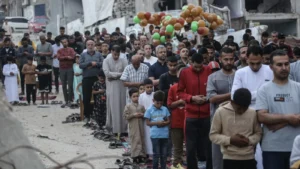
Palestinians perform morning prayers marking the start of Eid al-Adha, the Feast of Sacrifice, on a heavily damaged street in Khan Younis, southern Gaza, on 17 May 2026
Maram Humaid reports in Al Jazeera on 27 May 2026:
In her tent, where she has spent much of Israel’s genocidal war on Gaza, 68-year-old I’tidal Hamdan prepares for her third consecutive Eid al-Adha away from home.
**** ****
Eid without sacrifices
Emad Suhweil, 43, a displaced father of five from Beit Lahiya in northern Gaza, says that the absence of livestock in the markets means that Eid al-Adha has lost another component.
“Every year we used to sacrifice … we would slaughter, be happy, eat together, and distribute to the poor, those were beautiful days” he told Al Jazeera. “I used to buy a sheep or share in a calf.” The sacrifice traditionally ends with a feast that brings the whole family together around one table, creating a sense of joy and warmth. But amid the loss and the hardships, feasting is far from the minds of many people in Gaza this year.
“What is Eid al-Adha without sacrifices or Hajj. Today, people don’t even think about sacrifices … they can’t even afford two kilos of vegetables,” he adds. “We are all suffering to secure the most basic needs due to soaring prices.”
Although there are limited number of livestock in Gaza, buying an animal is far beyond the financial abilities of most families, says Suhwell. “The sheep that used to cost around 400–500 Jordanian dinars ($560–$700), or about 2,000 shekels, before the war now costs around 16,000–17,000 shekels ($4,400–$4,700) for a 50-kilogramme [110-pound] animal, and it is very weak,” he adds in astonishment.