

‘My land is forbidden to me’: Israel’s settlement push encircles Jenin
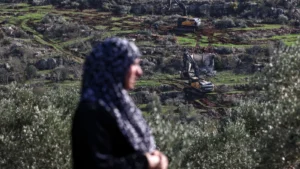
A Palestinian woman watches as Israeli bulldozers work on her land to make way for the construction of settlements west of Jenin in the occupied West Bank on 22 December 2025
Fayha Shalash and Muhammad Ateeq report in Middle East Eye on 26 August 2026:
Ahmed Zeidat was tending his olive trees in the occupied West Bank when a group of Israeli settlers came charging towards him. They punched him in the face and stomach. Zeidat fled on his tractor, with the settlers in pursuit.
Israeli soldiers eventually intervened, removing the settlers – and detaining Zeidat. His offence, he was told, was being on his own land. “When I asked the officer why I was being detained, he told me I was on private land that I wasn’t allowed to access,” the Palestinian farmer told Middle East Eye.
Bemused, Zeidat said: “This land is mine. How did it become private, and who does it belong to?” The soldier, according to Zeidat, replied: “It belongs to us, and you’re not allowed to enter it.” After a brief detention, Zeidat was released and ordered not to return.
“My land, the fruit of my labour and toil, is forbidden to me,” he said. “It used to give me 600 kilos of pure olive oil. Now I look at it from afar. I can’t even look, because my heart aches.”
For Palestinians in Jenin and the surrounding villages, Zeidat’s experience is becoming increasingly familiar. Since Israel’s unilateral disengagement in 2005, Palestinians in the northern West Bank had largely been spared direct contact with settlers. Israel dismantled four settlements in the area at the time – Ganim, Kadim, Homesh and Sa-Nur.
But since the current Israeli government took office in late 2022, settlement activity has accelerated across the West Bank. In and around Jenin, Israel has moved to re-establish the four evacuated settlements, approve new ones and build the military infrastructure needed to protect them.
Palestinians fear the result will be an expanding ring of settlements and military bases around Jenin, cutting the city off from neighbouring areas and tightening Israel’s control over land and movement.
Settlements and military bases
Israel has approved 11 new settlements in the Jenin area, in addition to the four it has revived, Tariq Ighbaria, director of the Wall and Settlement Resistance Commission (CWRC) in Jenin, told MEE. Settler families have already begun moving into some sites, while roads and other infrastructure are under construction.
In late July, the Israeli military seized nearly 200 dunams of Palestinian-owned land in Jenin through 15 military orders, according to the CWRC. Haaretz reported that the land was seized to connect two new settlements south of Jenin, Noa and Emek Dotan. The orders affect land designated as Area A under the 1995 Oslo Accords, which is supposed to remain under full Palestinian Authority control.
Israeli anti-settlement organisation Kerem Navot said it was the first time the army had used seizure orders in Area A to connect illegal settlements rather than for military purposes.
In June, Haaretz reported that the Israeli army was establishing a permanent military base in the heart of Jenin city – the first permanent military post it has built in Area A since the Oslo Accords. Sources told the newspaper the base was intended, among other purposes, to protect Israeli settlers returning to the area.
The changes are already reshaping the landscape. “The landscape of Jenin has changed significantly in recent months due to the return of settlers,” Ighbaria said.
Large swathes of Palestinian farmland and olive groves have been turned into construction sites, while bulldozers carve out roads and military installations.
“Bulldozing operations are also continuing in the mountains of Masliya and Qabatiya, while a military base is being constructed in the Jabriyat neighbourhood, classified as Area A and located in the heart of Jenin,” Ighbaria said.
He warned that the amount of land taken on the ground could be far greater than that specified in individual confiscation orders.