

Jews and Arabs have a shared stake in defending the right to protest
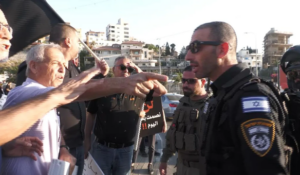
Israel Police officers confronting demonstrators in Umm al-Fahm, 2025
Yanal Jbareen writes in Haaretz on 6 August 2026:
At the end of last week, I took part in a demonstration in Haifa against settler violence in the West Bank. Another protest took place simultaneously in Tel Aviv. Seven protesters were arrested.
The next day, I returned to my hometown of Umm al-Fahm to participate in a demonstration bearing the same message. About 30 protesters stood by the roadside, holding signs that read “Stop the Massacre in the Occupied Territories” and calling for an end to the violence.
Superintendent Dudi Rosenthal, deputy commander of the Umm al-Fahm police station, took a megaphone and addressed the protesters: “Colors of the State of Palestine? Go to Palestine, east of here,” he said. Shortly afterward, the signs were confiscated, the demonstration was dispersed and four protesters were detained.
For anyone living in Umm al-Fahm, it was of course no surprise. Dispersing demonstrations, confiscating signs, making false arrests and using force have become a pattern in recent years. Yet still it’s hard to get used to. A police officer is supposed to enforce the law, not use a megaphone to argue with a political stance. When the police respond to a political protest with political messages, they aren’t merely dispersing a demonstration; they’re undermining the confidence that law enforcement is being carried out equally.
This crisis is nothing new. Ever since the events of October 2000, the trust of Arab citizens in the police has steadily eroded. The sense of abandonment in the face of crime and violence in Arab society, along with the attitude toward political protests, are causing many to feel that the police do not act to protect them to the same extent that they act against them.
Under the government of Prime Minister Benjamin Netanyahu and National Security Minister Itamar Ben-Gvir this feeling has only deepened. It is difficult to shake off the impression that the police, which should be a non-partisan government body, has become a tool carrying out the spirit of the political leadership rather than protecting the citizens’ fundamental liberties.
I find it hard to believe that police officers who acted violently or made false arrests will be held personally accountable. Such cases rarely ended in legal proceedings even prior to the current government and now there is also the fear of weakening the police oversight mechanisms – especially after the Knesset passed a law last month changing the way police misconduct is handled.
This week, the attorney general asked the High Court of Justice to issue an interim injunction against the law. In her request, she quoted Supreme Court Justice Alex Stein: “The politicization of criminal law is one of the clearest hallmarks of a tyrannical regime.”
This warning doesn’t apply only to the judicial system; it also touches on the situation exposed in the streets of Tel Aviv and Umm al-Fahm. When protests against the occupation and settler violence become targets and are silenced while oversight mechanisms over the police are weakened, what is harmed is not only the right to protest, but democracy itself.
This coming Saturday, Arab and Jewish citizens will take to the streets once again to protest. The question of whether the police will once again disperse the demonstrations, confiscate signs or make arrests is hardly being asked anymore. The experience of this past week shows just how real that possibility is.
The real question is whether the attempts to scare and silence us will deter us from continuing the struggle. As far as I’m concerned, the answer must be no. The right to protest is not granted to us by the police. It’s a basic right in a democracy. And precisely when they try to silence us, we must not remain silent.
And the struggle does not end in the street. We must translate the fear, the anger and the frustration over arrests, police violence and silencing attempts into political power. The path to changing this situation doesn’t stop at demonstrations; it also passes through the ballot box. The voter turnout in Arab society will be one of the factors determining whether the policy of recent years will continue.
Anyone who wants a professional police force instead of a political one, anyone who believes in civil equality, freedom of protest and the rule of law, can’t afford to stay home on Election Day.
This article is reproduced in its entirety