

Jerusalem Day, the Palestinian Kristallnacht
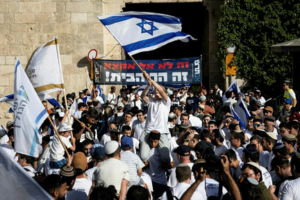
Participants in the Jerusalem Day Flag March stand with a banner reading ‘It’s not Al-Aqsa, it’s the Temple Mount!’ on 14 May 2026
Hanin Majadli writes in Haaretz on 17 May 2026:
It is hard to imagine a more apt coincidence: This year, Jerusalem Day nearly coincided with Nakba Day.
One day after Israel celebrated the “unified” city, Palestinians marked their Nakba. It goes without saying that these have never been two separate stories. The Israeli celebration of sovereignty, unification and “liberation” has always been based on a Palestinian history of loss, expulsion and longtime repression.
The Flag March, racist calls in the Old City of Jerusalem – especially the classic grouping, “Mohammad is dead,” “May your village burn” and “A Jew is a soul, an Arab is a son of a bitch” – the violence and the display of power, superiority and ownership are not the extreme fringes of this event but rather the most direct, blatant and sincere demonstration of Israeli sovereignty in Jerusalem. Not an exception to the natural order but rather a crude illustration of it.
To Palestinians in Jerusalem, Jerusalem Day has long been not only a day of deep distress, like a knife through one’s heart, but also a day when they need to physically prepare for danger. Arab streets and shops close early or do not open at all; families avoid leaving their homes, parents warn their children not to go out by themselves and people follow the routes of the march in order to know what places to avoid. All this on a day when the state, the police and the ultranationalist mob work in perfect harmony.
It is hard not to think of Kristallnacht. Not as a metaphor but rather as a sober, concrete comparison. There, too, violence was not confined to breaking windows or burning houses of worship: It was an organized public show of power, humiliation and the internalization of nationalist-racist hierarchy. An event in which mobs take to the streets with the full knowledge that the political order supports them, while an intimidated population shuts itself up indoors. This exact rationale underscores Jerusalem Day: an entire population learns it must diminish its presence in the public presence, bow its head and keep off the streets until the mob moves on.
Palestinians in Jerusalem and other mixed cities in Israel used to shut their windows on Israeli national holidays and wait for the crowds, wild with joy and a celebratory sense of independence, to move on. Nowadays, they are in fear for their physical safety. This is no mere fear of humiliation on the street or calls of “Death to Arabs.” This is a concrete fear that someone will break into their home, that an Arab appearance or accent will be enough to get one killed, or at least to earn a broken eye socket.
The truth is that the Flag March is no longer the sole province of messianic groups or gangs of ultranationalist teens. More and more Israelis have come to identify with Jerusalem Day, alongside the persistent erosion of the status quo on the Temple Mount/Al-Aqsa Mosque, including the gradual normalization of Jewish worship at the site; the passage of the Death Penalty for Terrorists Law and the general barbarization and joy of genocide, which have opened the door to unprecedented violence throughout Israel.
Meanwhile, the Israelis who view themselves as liberal, secular and democratic cling reverently to their symbols: the flag, the military, “unified” Jerusalem and the worship of Jewish power.
Against the backdrop of living in an ongoing Kristallnacht, even Palestinian rage no longer exists. It has been replaced by numbness, despair and a deep political fatigue. There is something exhausting about living in a reality in which violence is no longer considered a bug but rather a feature of life in your homeland.
This article is reproduced in its entirety