

Israel’s starvation of Gaza leaves children stunted
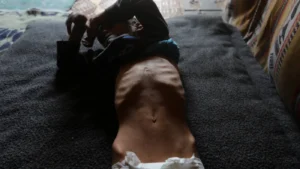
Ten-year-old Mohammed Ahmed Massoud al-Sousi, who suffers from malnutrition due to Israeli restrictions on aid entering Gaza, sits inside a tent in Gaza City on 6 May 2026
Nada Nabil reports in Midddle East Eye on 19 August 2026:
In a small room in Gaza City’s Sabra neighbourhood, six-year-old Amira Rashid lies on a mattress, too weak to move. Her hands are bruised and blue from the intravenous drips she has been receiving.
Under normal circumstances, the Palestinian girl would be preparing to start her first year of school later this month. Instead, months of starvation by Israel during the genocide in Gaza have left her severely malnourished and stunted, with lasting effects on her physical and cognitive development.
“I was hoping to enrol Amira in school, buy her a uniform, a backpack and stationery like the other children,” her mother, Aya Rashid, told Middle East Eye. “But her health prevents her from leaving the house or interacting with her peers.”
Amira was among tens of thousands of children who suffered malnutrition during Israel’s siege on Gaza, which began in October 2023. Her family was also among hundreds of thousands who remained in northern Gaza throughout the war. In August 2025, the UN-backed Integrated Food Security Phase Classification (IPC) declared famine in Gaza City, where the Rashid family lived. “We suffered immensely from hunger and severe food shortages,” Aya said.
“We ran out of flour, and there was none in the markets. With no food aid available, I could only manage to bake barley bread.”
**** ****
Humanitarian crisis
Despite the severely limited capacity of Gaza’s remaining hospitals, medical points and clinics, families of malnourished children have nowhere else to turn for care. Israel’s blockade has devastated the territory’s healthcare system while imposing strict restrictions on medical travel abroad.
Dr Mohammed Abu Rai, head of the nutrition clinic at al-Rantisi Hospital, told MEE that the facility receives dozens of malnourished children every day, forcing staff to open additional wards to cope with the influx.
Although a new report by the IPC this month recorded a decline in acute malnutrition following the ceasefire, it warned that more than 74,000 children would still require treatment for acute malnutrition through April 2027.