

Israel’s denial of the widespread killing in Gaza was a strategic choice
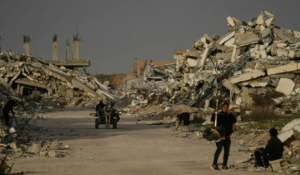
Palestinians walking amid the ruins left by the Israeli air and ground offensive in Zahra, central Gaza, in January 2026
Yagil Levy writes in Haaretz on 23 February 2026:
The number of dead civilians is an ongoing point of dispute in every war these days. This dispute is characterized by methodological arguments about how the dead are counted, but behind it lies a clearly political issue: The one who controls the numbers also controls the narrative that the war creates. The war in the Gaza Strip is no exception in this regard.
Gaza’s Hamas-controlled Health Ministry provided data on the number of people killed throughout the war. Israel claimed those figures were unreliable, but the world accepted them as credible and even claimed that they were an underestimate. The army also recently announced that it accepted their credibility.
-This preoccupation with the numbers reveals the mechanisms of denial that allowed Israel to kill at least 70,000 Gazans, the vast majority of them civilians, who are protected by international law. These mechanisms of denial played a critical role with regard to Jewish Israelis who identify with the center-left.
Their blind support for the war was essential for the government to artificially extend it in the name of the delusion of destroying Hamas. And preserving this delusion required obscuring the moral price. Alongside the media’s active role in this concealment, official Israel also contributed to obscuring the number of people killed.
This is the first war in Gaza in which Israel refrained from releasing numbers of its own. Yet state institutions could presumably have collected data about the killing of civilians had they wanted to do so, or at the very least, verified or rebutted the reports from Gaza.
This is sometimes called “strategic ignorance.” Stressing the unreliability of numerical estimates turned ambiguity into an asset for people who wanted to justify the war. In this way, discussion was diverted from the moral question to the technical one of how the dead were counted. And indeed, many Israelis became experts in methodologies of counting the dead to challenge Hamas’ numbers, thereby helping to obscure the war’s moral price.
Had Israel admitted the credibility of the Gazan data, as it did recently, this would have bolstered awareness, both domestically and abroad, of the war’s price and intensified pressure to end it. There is no better evidence of the state’s success domestically than the fact that on the second anniversary of the start of the war, shortly before it ended, the vast majority of the public believed the war should end, according to the Israel Democracy Institute, yet even among Jews who identified as leftists, only 5 percent thought it should end because of the harm it was causing civilians.
A complementary denial mechanism is what sociologist Stanley Cohen termed “implicatory denial.” This isn’t a denial of either the facts or their accepted interpretation, but a removal of responsibility for their moral implications. Thus even ostensibly moderate Israelis who did not deny the Gazan data (we’ll set aside those who were proud of the number of people killed) justified the killing by claiming that Israel was fighting more morally than America did in Iraq.
This claim has no factual basis. Even if we accept Israel’s exaggerated claim that it killed some 23,000 terrorists (a claim amplified by the Institute for National Security Studies), that means at least two-thirds of the fatalities were civilians. That’s two-thirds of the 70,000 that Gaza’s government reported killed, a figure that Israel, as noted, now accepts. That’s a higher percentage than in the Iraq war, where the proportion of civilian deaths for which America and its allies were directly responsible was roughly half of all fatalities.
Israel’s announcement that it accepts the credibility of the Gazan data may therefore be a first step on the journey toward accepting responsibility for what it did in Gaza.
This article is reproduced in its entirety