

Israel wants to execute Palestinians and the world will allow it
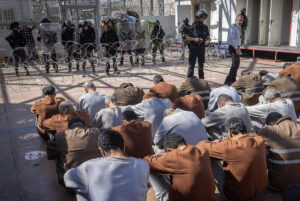
Prisoners seen at a courtyard in a prison in southern Israel, 14 February 2024
Mohamad Alqeeq writes in Al Jazeera on 21 February 2026:
The Israeli Knesset is pushing through a bill that, if passed, would allow the occupation authorities to legally execute Palestinians. This development has attracted hardly any international attention, but for Palestinians, it is yet another looming horror.
The bill is part of the deal that allowed the formation of Benjamin Netanyahu’s coalition government in late 2022. It was demanded by Itamar Ben-Gvir, now national security minister, who has led a reign of terror across the West Bank for the past three years.
In November, the bill passed its first reading, and in January, its provisions were revealed: execution carried out within 90 days of sentencing, no appeals, and death by hanging. Palestinians charged with planning attacks or killing Israelis would face the death penalty. Ben-Gvir has repeatedly called for the execution of Palestinians, most recently during his visit to Ofer Prison, where he filmed himself overseeing the abuse of detainees.
That we got to this point is hardly surprising. For decades, the international community has neglected the fate of Palestinian prisoners. In the past two and a half years, there has been almost no global reaction to the mass brutalisation of Palestinians held in Israeli jails with or without charges. Israeli efforts to legalise executions of Palestinian is the logical next step in eliminating the Palestinian question.
‘Prisoners’ or captives?
The use of the term “prisoners” to refer to Palestinians held by Israel is deceptive. It strips this cruelty of its context – the military occupation and colonisation Palestinians live under. Prisoners of war or captives are much more accurate terms. That is because Palestinians are taken away either for resisting the occupation or for no reason at all – for the sake of terrorising their families and communities.
Currently, more than a third of the Palestinians Israel is holding are under “administrative detention” – ie, they are being held without charge – and some are women and children. Palestinians are also “tried” in military courts, which are blatantly biased against the occupied population.
I, myself, was a victim of this system of oppression through unjust detention. In November 2015, Israeli soldiers burst into my home in Ramallah and took me away. They tortured and isolated me for weeks without even telling me what I was accused of.
Eventually, they came up with an accusation of “incitement”, for which they did not produce any evidence. They kept me under their “administrative detention”, or what is really an arbitrary arrest. The abuse continued, and during one interrogation session, an Israeli officer threatened me with rape.