

Israel’s approval of limited Gaza force a calculated manoeuvre, experts say
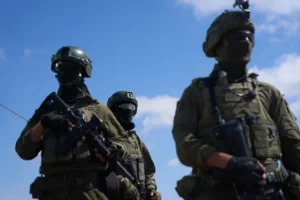
Israeli soldiers occupy a military position overlooking the Yellow Line in central Gaza on 26 May 2026
Mohammad Mansour reports in Al Jazeera on 27 July 2026:
Months after the United Nations Security Council backed a comprehensive framework to end Israel’s genocidal war on Gaza, Israel’s security cabinet has approved a highly constrained pilot project to allow foreign security forces into a narrow pocket of the devastated territory.
Israeli media reported on Sunday that the so-called International Stabilization Force (ISF), part of United States President Donald Trump’s 20-point “peace plan”, will include 200 members from countries such as Morocco and Uganda deploying to a designated “test” zone in the southern city of Rafah.
While international officials have welcomed the move, analysts describe the limited deployment as a calculated diplomatic gesture with little practical effect that comes as the US-backed peace process has largely stalled and as Israel’s deadly attacks continue.
Instead of a genuine transition towards peace, they argue, the move is a political manoeuvre designed to deflect US pressure ahead of Prime Minister Benjamin Netanyahu’s visit to Washington this week, while simultaneously entrenching the geographic fragmentation of the Gaza Strip.
“Netanyahu is going to Washington to say ‘no’ to the broader demands of withdrawal” from the Strip, says Wissam Afifa, a Gaza-based political analyst. “Instead, he is offering this alternative: ‘Take this small appetiser, take this minor achievement, and play within this highly restricted space.’”
Scaled-back forces and ‘rubber batons’
The Israeli daily Haaretz reported that the original plan anticipated the deployment of 500 Moroccan troops to a refugee camp in the city. The drastic reduction to just 200 troops may indicate that Israel’s political-security cabinet has decided to divide the deployment into even smaller, heavily controlled stages.
The force will operate in full coordination with the Israeli military. According to the Israeli news outlet Ynet, National Security Minister Itamar Ben-Gvir was the sole cabinet member to vote against the measure, arguing that the Palestinian group Hamas had failed to fulfill its commitment to disarm and insisting that “the solution in Gaza is to encourage migration”.
Israeli media also reported that the government maintains that the Israeli military will retain control of the “Yellow Line” – a unilaterally imposed boundary that effectively places up to 70 percent of the Gaza Strip under tight Israeli control – and that no withdrawal will take place until Hamas has fully disarmed.
The original framework endorsed by UNSC Resolution 2803 called for the deployment of an international force alongside a transitional Palestinian administration.