

Israel used the Nakba not only to steal land but Palestinians’ financial wealth too
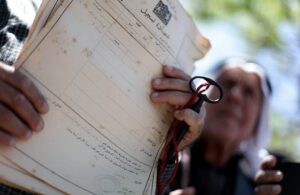
A Palestinian man shows deeds to his land during a rally marking the Nakba in Gaza City on 15 May 2013
Najib Antoine Jabre writes in Mondoweiss on 10 May 2026:
The loss of Palestinian homes in 1948 was not only the loss of roofs, orchards, and property deeds. Many Palestinians also lost access to bank accounts, deposits, securities, safe-deposit boxes, receivables, and legal claims. The event is often described through the language of war and exile. Yet another story appears in law offices, land registries, ministries, and financial institutions, where Palestinian absence was converted into a legal instrument.
The decisive act was not simply to record that people had departed. It was to classify them as “absentees.” The 1950 Absentees’ Property Law, together with the emergency regulations that preceded it, altered the legal meaning of absence. What had been a fact of displacement became a status. A Palestinian who crossed a border, found shelter in another part of Palestine, even a few feet from his home, or was unable to return during the prescribed period could be treated as legally absent, even when that absence resulted from war, fear, expulsion, or blocked return. Some Palestinians who remained within the newly established state were classified as “present absentees”: physically present in the country, but legally absent from their own property.1
A transfer of control then followed. Once property was classified as absentee property, it vested in the Custodian of Absentee Property. The word “vesting” sounds administrative, almost neutral. In substance, it meant that the owner’s rights passed to a public Israeli authority empowered to manage, lease, sell, or transfer those assets. The Development Authority and subsequent land legislation then helped move property into state and quasi-state channels. Retrospective validation and restrictive evidentiary rules made recovery increasingly remote.
The language of “abandoned property” is therefore misleading. A house is not abandoned when its inhabitants are driven out, barred from returning, or converted by law into absentees. A bank account is not abandoned because its depositor is Palestinian and has become a refugee. A citrus grove does not lose its owner because the road back has been closed by Israel. The legal classification did not merely describe absence; it turned absence into a mechanism of power.