

Israel opens just one Gaza crossing for humanitarian aid after US pressure
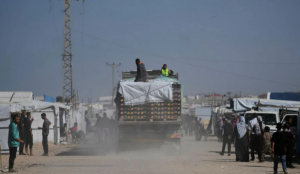
rucks carrying food, after entering the Gaza Strip through the Kerem Shalom crossing, drive through Khan Yunis
Liza Rozovsky, Jack Khoury and Nir Hasson report in Haaretz on 4 March 2026:
Under pressure from the United States, Israel reopened the Kerem Shalom crossing shortly before midnight on Monday to allow humanitarian aid into the Gaza Strip.
Haaretz has learned that the decision was made the previous evening after Aryeh Lightstone, a senior adviser to U.S. Middle East envoy Steve Witkoff and an adviser to the Board of Peace established by U.S. President Donald Trump, approached Prime Minister Benjamin Netanyahu and asked him to resume aid deliveries to Gaza.
Lightstone’s appeal came after the IDF Coordinator of Government Activities in the Territories (COGAT) announced on Saturday that all border crossings into the Strip would be closed due to the security situation with Iran, until further notice.
The decision to reopen Kerem Shalom for humanitarian aid was published shortly before midnight Tuesday on COGAT’s X account.
Only a few hours earlier, COGAT had posted a lengthy message justifying the closure on security grounds. “Opening the crossings under fire endangers lives, both of staff on the Israeli side and staff on the Gaza side,” it said. “The crossings will reopen once the security situation allows.”
The High Representative of Gaza’s Board of Peace, founded by U.S. President Donald Trump, wrote on Tuesday night that the opening is “a result of a sustained engagement with all relevant parties.” “The basic needs of Gaza’s population cannot be delayed,” High Representative Nikolay Mladenov added.
Despite Kerem Shalom’s opening, other crossings into the Strip remain closed, including Kissufim and Zikim, which are used for humanitarian aid deliveries. The Rafah crossing on the Egyptian border, through which people had returned to Gaza in recent weeks, is also shut. The Allenby Bridge crossing between Jordan and the West Bank has likewise been closed to goods and humanitarian aid following a decision by the Israel Airports Authority, which oversees the crossing.
In response, the UN said on Tuesday that the other crossings “must be open to enable the scale up of the response to meet the immense needs of people in the Strip.”
COGAT earlier said the crossings’ closure “will have no impact on the humanitarian situation in the Gaza Strip,” adding that the volume of food entering since the cease-fire between Hamas and Israel began in October amounts to “four times the nutritional needs of the population, according to UN methodology.” The unit added that “existing stock inside Gaza is expected to suffice for a while.”
However, residents who spoke with Haaretz reported sharp price increases and said some traders were now hiding their goods instead of selling them. As a result, basic items including flour, oil and sugar have disappeared from markets.
Despite the rapid impact on conditions in Gaza, the closure of the crossings and the halt in aid deliveries appear to have largely passed under the radar internationally. Although humanitarian supplies to Gaza are central to U.S. and international efforts to preserve the cease-fire, improve living conditions in the Strip and implement U.S. President Donald Trump’s 20-point plan, the wider turmoil across the Middle East has pushed Gaza down the agenda.
Palestinians buy groceries at the Zawiya Market in Gaza City during the Muslim holy month of Ramadan on Thursday. Credit: Jehad Alshrafi/AP
The reopening of the Rafah crossing for Gaza residents had been a focus of international attention until the war with Iran erupted – now, Israel and Egypt are engaged in a quiet but tense dispute over the issue.
Gaza’s economy depends almost entirely on supply mechanisms linked to Israel, and the closure of the crossings triggered panic in the markets. “People rushed to buy flour, sugar and dry goods not because there is abundance, but because there is memory,” a Gaza resident told Haaretz.
Palestinians crowd markets in downtown Gaza City after the closure of humanitarian aid crossings, on Saturday. Tiktok: ahmed_omar550
A video filmed on Saturday in central Gaza City and circulated online shows crowds surrounding traders who appeared to be selling sugar. One trader can be seen whipping the crowd with a lash. A witness who spoke with Haaretz said the crowd rushed for the food out of fear of shortages. “The public went crazy,” another resident said. “People are terrified of hunger.”
According to a source in Gaza, food prices have already risen following the closure of the crossings. A 25-kilogram sack of flour now sells for 60 to 100 shekels, while a kilogram of sugar costs about 30 shekels. Prices are still lower than during the war itself but higher than they were after the cease-fire began. One trader in Gaza told Haaretz that price controls in the Strip remain effective and that merchants are not free to raise prices as they wish.
Gaza slipping off the agenda
In Gaza and across the Palestinian arena, there is growing concern over the war between Iran and Israel. The main fear is not necessarily that the fighting will expand, but that Gaza will drop off the agenda – not only in Jerusalem, but also in Arab and international forums.
“Everything is going into deep freeze,” said an Arab diplomat from one regional country. Speaking to Haaretz, he added: “Once the headlines are about Tehran, international attention shifts. Gaza is no longer at the top of the priority list.”
Gazans share that concern. A human rights activist in the Strip said that even before the current escalation, there had been little real progress on the ground. Since the cease-fire was declared and mechanisms tied to the Board of Peace were presented, he said, no concrete steps have followed.
“They talk about a technocratic government, about a Board of Peace, about seven billion dollars in donations, about an international stabilization authority – but in practice nothing is moving,” he said.
Trump’s Board of Peace
The Board of Peace
Comprised of heads of state, invited by Trump. Trump chairs the board, and its votes and decisions will be subject to his approval. Terms will be limited to three years and will be renewable with his approval, except for countries that contribute more than $1 billion in the first year.
The Executive Board
Will be tasked with setting the agenda for the Board of Peace.
Members include Steve Witkoff, Jared Kushner, Marco Rubio, Tony Blair, businessman Mark Rowan, World Bank President Ajay Banga and U.S. Deputy National Security Advisor Robert Gabriel.
Aryeh Lightstone and Josh Gruenbaum are senior advisers.
Office of the High Representative
The Office of the High Representative will be headed by former UN Special Coordinator for the Middle East Peace Process Nickolay Mladenov. The White House described his role as an “on-the-ground link between the Board of Peace and the National Committee for the Administration of Gaza, or NCAG.”
Gaza Executive Board
The Gaza Executive Board will support the Office of the High Representative.
Though the scope of its authority is unclear, its members include Turkish Foreign Minister Hakan Fidan; Qatari diplomat Ali Al-Thawadi; Egypt’s spychief Hassan Rashad; Emirati Minister Ebrahim al-Hashimy; former Middle East envoy for the UN, Sigrid Kaag; Cypriot-Israeli businessman Yakir Gabay; Marc Rowan; Nickolay Mladneov; Tony Blair; Steve Witkoff; and Jared Kushner.
National Committee for the Administration of Gaza, or NCAG
The National Committee for the Administration of Gaza is a technocratic committee made up of Palestinians overseen by the Office of the High Representative. Dr. Nabil Ali Shaath, who previously served as deputy transportation minister in the Palestinian Authority, will lead the committee.
It is unclear whether the new administration will enjoy real freedom of action or broad public legitimacy.
The Civil-Military Coordination Center in southern Israel, which oversees the Gaza cease-fire and coordinates aid deliveries, has also shifted to very limited activity since the start of the attacks on Iran. According to a civilian source at the center, international representatives have been barred from accessing it, and only a small number of U.S. and Israeli officials continue to work there. The source said an Egyptian representative was allowed to enter the facility on Sunday.
There are additional signs that the center is no longer a priority for Washington. In February, the military command of the center passed to a lower-ranking officer. In mid-March, the U.S. Army’s 36th Infantry Division is scheduled to deploy to Kuwait, a move likely to divert at least some of its attention away from humanitarian coordination and monitoring the cease-fire in Gaza.
This article is reproduced in its entirety