

I’m queer and Palestinian. Jerusalem Pride is not my celebration
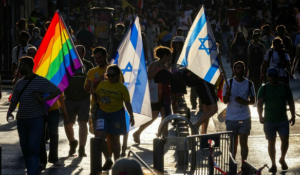
Jerusalem Pride 2025
Orwa Adam writes in Haaretz on 4 June 2026:
Every time I see a campaign that presents Israel as an “LGBTQ paradise,” I ask myself if we even live in the same country. Because I am not only queer, I am also a Palestinian Arab citizen of Israel, and the moment that detail is added, the entire enlightened narrative that Israel so loves to sell the world begins to crumble.
Today, the Pride parade will march in Jerusalem, this highly charged city, which is currently celebrating its “unification” – a unification that manifested in the annexation of hundreds of thousands of Palestinians, reducing them to the status of subjects devoid of civil rights, and which is celebrated annually with a fascist and violent Flag March.
I cannot march with pride in a city that so clearly symbolizes the discrimination and oppression of my Palestinian brothers, even if, on the “right” side of the Green Line, their lives are supposedly easier. True, in Israel, gay men are not stoned as a matter of national policy. But life here is far from ideal for LGBTQ people, even if there is an Amir Ohana to wave as an achievement (and most gay men are ashamed of him anyway).
The world knows the Tel Aviv Pride parade, the rainbow flags, the beach parties and the colorful images. Less known is the feeling of entering a room and seeing people’s attitudes change the moment they hear your name; less known are the glances, the suspicion, the feeling that you always have to prove you belong. I, however, know it well.
In Israel, some minorities are more accepted and some are less accepted. There are identities that are convenient to present to the world, and identities that are less convenient to talk about. When the state needs to show how liberal it is, it likes to present LGBTQ people; when it needs to confront the question of how it treats its Arab citizens, suddenly the conversation becomes much less comfortable. And when it has a minority within a minority – Arab LGBTQ people – it becomes altogether more complex.
A country whose security infrastructure also relies on blackmail based on sexual orientation by its security organizations within conservative societies, like the one I come from, cannot boast of enlightenment or parades.
I am not observing Israel from the outside. I work here, pay taxes here, contribute to society here and have lived my entire life here. And yet, there are moments when I feel that certain people are willing to accept me only on the condition that I leave parts of myself outside the door. But I refuse to choose between my national identity and my sexual identity; I refuse to be the convenient LGBTQ person or the convenient Arab; I refuse to be silent so as not to spoil someone’s beautiful narrative about the country.
I do not ignore the difficulties that also exist within Arab society. As someone who lives this reality, I am well aware of the fear, the silences, the judgment and the prices that LGBTQ people sometimes pay within their families and communities. But change is already happening on the ground: I see braver young people, families beginning to listen and new voices refusing to accept the situation as it was in the past.
In contrast, in supposedly Western and advanced Israel, the situation is only regressing, both with regard to LGBTQ people and Arabs, even if a symbolic parade marches through the capital’s streets (and in any case, a truly free and LGBTQ-friendly country would not have needed to fence and secure it so heavily).
A country is not judged by how beautifully it photographs for the Pride parade; it is judged by how it treats those at the intersection of several marginalized identities. If I, as a Palestinian Arab queer person, still have to fight to be seen as a whole person here in Israel, even in a supposedly accepting and inclusive society, there is no reason to be proud that Israel treats LGBTQ people better than other places. In the Middle East, that is a pretty low bar.
Orwa Adam is a social activist for the Palestinian LGBTQ community.
This article is reproduced in its entirety