

IDF pushes for renewed large-scale Gaza offensive citing Hamas resurgence
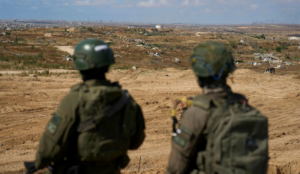
IDF soldiers occupy a military position overlooking the Yellow Line in the central Gaza Strip, May 2026
Yaniv Kubovich, Jack Khoury and Rawan Suleiman report in Haaretz on 10 June 2026:
The Israeli army is preparing for the possibility of a return to large-scale fighting in Gaza, amid cease-fires in Iran and Lebanon and assessments that Hamas has used recent months to significantly rebuild its military and organizational capabilities, IDF officials said.
IDF Chief of Staff Eyal Zamir has, in recent weeks, approved several operational plans presented by the IDF Southern Command as part of discussions on renewing ground operations in the Gaza Strip. According to army sources familiar with the matter, Yaniv Asor, the IDF’s Southern Command chief, argued that no international body has so far emerged that is capable, willing or genuinely able to disarm Hamas, meaning the IDF will eventually be required to carry out a major offensive in Gaza.
Israeli security sources said the IDF Southern Command has presented intelligence assessments to the Israeli government indicating that Hamas has managed to restore parts of its infrastructure, including sections of its underground tunnel network damaged during the war. The IDF also believes the group has rebuilt its headquarters and command-and-control systems after many senior military leaders were killed in Israeli strikes.
Senior IDF officers have been pushing internally to advance the approved plans. According to sources, Asor has argued in closed discussions that Israel cannot rely on the current situation or on operations limited to the buffer zones along Gaza’s perimeter, which Israel has taken substantial control of.
At the same time, Israeli political sources stressed that the government has not yet approved plans to expand the fighting, despite Prime Minister Benjamin Netanyahu’s push to preparations. The IDF believes that if such a decision is made, troops will have to enter areas it has largely avoided until now due to concerns that hostages may be held there, including parts of central Gaza’s refugee camps, the Muwasi area in southern Gaza, where many displaced Palestinians have been concentrated, and large sections of Gaza City.
According to officers in the IDF Southern Command, forces deployed along Gaza’s security perimeter are currently focused mainly on defensive missions and force protection around the Yellow Line, separating the Israeli-controlled area from the rest of Gaza.
“The troops are essentially standing guard and protecting themselves,” an Israeli security source said. “No significant offensive operations are currently being carried out, even when there is occasionally intelligence that could enable them.” The IDF noted, however, that it continues to strike immediately when real-time intelligence indicates that militants are preparing attacks on Israeli forces.
Meanwhile, talks are underway in Cairo between Palestinian factions under Egyptian mediation in an effort to reach agreements on Gaza’s future governance and the issue of Hamas disarmament. According to emerging understandings and Palestinian sources familiar with the negotiations, one of the key issues concerns the terminology used to describe what will happen to Hamas’ weapons.
Sources with knowledge of the talks said draft texts under discussion now state that Hamas would “lay down” its weapons, replacing earlier language that said it would “hand over” its weapons. The change is significant because it implies Hamas would not surrender its arms directly to Israel, but rather transfer them to an agreed Palestinian body. That body could be a force operating under the technocratic committee expected to administer Gaza, or potentially a force affiliated with the Palestinian Authority if a consensus is reached.
The sources added that the phrase “laying down arms” is intended to give Hamas political flexibility and avoid any suggestion of capitulation or the direct surrender of weapons to Israel.
The agreement also addresses the question of who will govern Gaza. Since the technocratic committee was established several months ago, Israel has refused to allow its members to enter the Strip. According to information obtained by Haaretz, if the committee does assume control of Gaza, it will be responsible for day-to-day security and for operating civilian policing mechanisms.
At the same time, sources familiar with the talks stressed that many details remain unresolved, and that some reports published in recent days do not reflect final agreements reached between the parties.
Dr. Mustafa Barghouti, chairman of the Palestinian National Initiative and one of the factions taking part in the talks, told Haaretz that the factions are seeking to advance a gradual framework. According to him, the terms of the Gaza cease-fire have not yet been fully implemented, and only once they are can the emerging framework move forward.
In the first stage, he said, the plan would include halting the expansion of the Israeli occupation, withdrawal from the areas where the IDF is currently operating, and the dismantling of armed militias backed by Israel. In the second stage, he said, it would be possible to address Gaza’s reconstruction, political and administrative reforms, and disarmament.
“You cannot expect people to give up all their means of defense while five armed gangs continue to operate on the ground under Israel’s protection,” he said. Barghouti said the mediators and participants in the talks voiced real concern that those militias could commit serious massacres, “even worse than Sabra and Shatila,” referring to the 1982 killing of hundreds to thousands of Palestinian and Lebanese Shiite civilians in Beirut refugee camps by a Lebanese Christian militia operating under Israeli control of the area.
Barghouti accused Israel of supporting the Gaza gangs, saying that “whoever provides them with weapons, equipment and protection cannot disavow responsibility.”
Barghouti added that Israel is working to create conditions that would push Gaza residents into forced migration. He cited statements by Defense Minister Israel Katz, arguing that the current policy is further worsening already dire living conditions in the Strip to encourage people to leave.
Referring to international pressure on Netanyahu, Barghouti said the mediators understand that, aside from U.S. President Donald Trump, there are almost no actors capable of effectively pressuring Netanyahu. He argued that there is an attempt to shift the public debate toward the question of weapons, while the main problem is the failure to implement understandings already reached.
“Weapons are not the first problem that must be solved,” he said. “If the first stage of the understanding is implemented, it will be possible to move to the next stage and address the other issues as well.” According to Barghouti, the final stage of the understandings would advance a political track leading to the establishment of a Palestinian state, in line with international initiatives.
This article is reproduced in its entirety