

‘A fantasy’: How the Palestine Action ruling whitewashed the history of civil disobedience
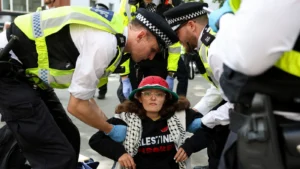
Police detain a demonstrator following a Court of Appeal ruling on the lawfulness of proscribing Palestine Action under terrorism laws, outside the Royal Courts of Justice in London, 15 June 2026
Katherine Hearst reports in Middle East Eye on 17 June 2026:
On Monday, five judges quashed a High Court ruling that found the UK government’s proscription of direct action group Palestine Action to be unlawful.
In its judgement, the Court of Appeal noted the group’s “covert” nature, saying that it is not “as it claims, a direct action civil disobedience group like the suffragettes”.
“It is a covert organisation that operates using secret cells to avoid the detection and prosecution of those using violence to destroy the property of third parties. Palestine Action’s activities have caused injury as well as property damage,” Lady Chief Justice Sue Carr said.
Commentators have pointed to the misconstruing of the suffragettes’ campaign as non-violent and “operating transparently in the open”. “They are propagating a fantasy,” former government lawyer Tim Crosland told Middle East Eye. “The whitewashing of that history, making out that they broke at half time to have cucumber sandwiches with the police is quite alarming.” The Women’s Social and Political Union (WSPU), the militant wing of the British suffrage movement, initially campaigned openly but escalated its tactics after 1912, carrying out arson and bombing attacks targeting public venues, infrastructure and the homes of anti-suffrage politicians.
With the adoption of more militant tactics, the movement shifted to operating more covertly – in a manner that academic researchers have said met “the definitional criteria of what we call a ‘covert social movement network’ (CSMN)”. A secret cell, known as the Young Hot Bloods, was set up to conduct the attacks, with members pledging to “danger duty”. While the attacks primarily targeted property, they caused some injuries and fatalities. The women planted crude homemade bombs in packed train carriages and even sent vials of phosphorus in the post, severely burning postmen. The police denounced their campaign as a “reign of terror”, while newspaper headlines branded their actions as “Suffragette Terrorism”.
In a pamphlet entitled Why We Are Militant, the movement’s leader, Emmeline Pankhurst, said: “The only justification for violence, the only justification for damage to property, the only justification for risk to the comfort of other human beings is the fact that you have tried all other available means and have failed to secure justice.”