

IDF hostage chief says Gaza hostages could have ‘returned alive’ but Netanyahu gov’t refused truce deals
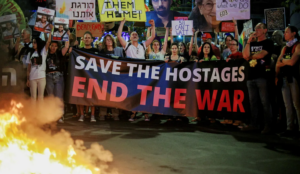
A protest for the release of the hostages held in the Gaza Strip in 2025
Yaniv Kubovich and Liza Rozovsky report in Haaretz on 1 July 2026:
The former head of the IDF’s Hostages and Missing Persons Command said on Wednesday that after October 7, Israel “conducted a long war that could have ended at least a year earlier,” adding that there were hostages held in Gaza that could have “been returned alive.”
According to the former chief of the unit, Maj. Gen. (Res.) Nitzan Alon, Israel “could have achieved the same results or avoided failing to achieve those we did not achieve, such as disarming Hamas, and so on.”
“We paid a heavy price in soldiers killed, perhaps even some hostages killed, immense costs in blood and money that were not necessary,” he said.
Speaking at the Herzliya Conference of the Institute for Policy and Strategy at Reichman University, against the backdrop of an emerging agreement between the United States and Iran and the cease-fire framework between Israel and Lebanon, Alon said that referring to Gaza as a failure is an understatement akin to “throwing dust in the eyes of the public.”
“Approximately 40 hostages who were taken hostage alive that were killed in captivity,” he said, adding that negotiations could have “brought them back alive.”
The Likud party responded to Alon, saying that he “asked to surrender to Hamas’s conditions, withdraw from Gaza and end the war, while simultaneously leaking briefings from the most sensitive discussions and harming the negotiations.” The party added that it was “a good thing Prime Minister Benjamin Netanyahu did not listen to him,” arguing that otherwise Israel would not have reached several of what it lists as its achievements during the war – including assassinations of senior Hamas and Hezbollah officials, military control over most of Gaza, and the return of the hostages.
Alon also criticized Finance Minister Bezalel Smotrich, who recently took credit for the return of the Gaza hostages, calling him “the one who opposed some of the agreements at various stages, and I do not think he can take credit for the return of all the hostages.”
In an interview on former reporter Nadav Perry’s podcast, the far-right minister said that by pressuring Prime Minister Benjamin Netanyahu to continue the military assault, he claimed he had cut short negotiations about a limited number of hostages. Smotrich also said he had a “dramatic, if not decisive” influence on the conduct of the war.
The minister’s comments sparked a wide backlash from those affected by the October 7 attack, including former hostage Or Levy, who addressed Smotrich, saying, “If you mean that ‘thanks to you’ hostages were murdered while you thwarted deals, then sure.” Alon noted that Smotrich, along with other ministers, repeatedly blocked hostage deals “in the name of that same ‘total victory,’ which is a falsehood.”
“The push for partial proposals in various forums, or the alternative of a partial agreement versus a broader one, meant choosing a partial deal to allow continued fighting,” he said, adding, “Strategically conducting a war for more than two years until the American administration forced its end – this was not the optimal path given the price we paid.”
He further accused the Israeli government of creating an “irreversible reality of population mixing, outposts, settlements, farm” in the West Bank as part of a “long-term plan” that will “not permit Palestinian territorial continuity.” He added that violent hilltop youth have been given the role of soldier and even “significant roles in the government,” which he described as Israel’s use of “militias and other proxy forces” in the West Bank.
He argued that he is “not convinced that buffer zones will provide long-term security for Israel,” referring to Gaza and Lebanon.
This article is reproduced in its entirety