

IDF blocks return of Palestinians to West Bank refugee camps; UN data shows 33,000 remain displaced
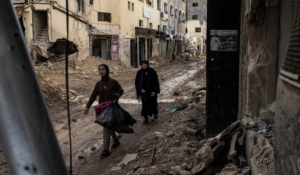
Destroyed buildings in the Jenin refugee camp 2025
Matan Golan reports in Haaretz on 26 August 2026:
The Israeli government told the High Court of Justice this week that the Israeli military continues to oppose allowing residents of the Jenin, Tulkarm and Nur al-Shams refugee camps in the West Bank to return to their homes, as UN data shows over 33,000 remain displaced.
According to the Israel State Attorney’s Office, the Israel Defense Forces is also preparing to maintain long-term operational control in the area, a year and a half after the operation began.
The IDF’s position was submitted in response to a petition filed by the Association for Civil Rights in Israel, which argued that tens of thousands of residents had been suddenly, violently and humiliatingly evacuated from their homes and are now dependent on limited aid from humanitarian organizations.
In its response, submitted on Monday, the state said the defense establishment had found that the prolonged operation and continued military presence were more effective than previous short-term operations, “leading to a decrease in the organizational capability of the battalions” in the three refugee camps and, consequently, to fewer terror attacks and warnings of planned attacks.The immediate and significant improvement in the security situation was also reflected in a decrease in crime in the main cities of the northern West Bank, the state said. However, it noted that intelligence assessments indicate that armed groups in the camps may seek to rebuild their capabilities once the military operation ends. Weapons have also been found in the camps in recent months, according to the response.
Although the state emphasized that the forces “do not seek to remain in the refugee camps permanently,” it wrote that the army is planning operations that will give it operational control over routes breached in the camps, even after the end of the operation, which began in January 2025.
In addition, the state reported that work began in June on establishing a new military post near Jenin, which is expected to be completed within a few months. Except for two posts established in the H1 area, which is the Palestinian side of the city of Hebron, this marks the first time since the 1993 Oslo Accords that the IDF has built a permanent military post in an area under the Palestinian Authority’s full civil and security control.
The government further said that the possibility of establishing similar military posts near Tulkarm and Nur al-Shams is being examined. It added that it has held talks with the Palestinian Authority regarding handing back responsibility for security and public order in the camps, but acknowledged that in recent months there has been “no real progress” on the matter. Due to the ongoing military activity, it said, no significant repairs have been made to damaged infrastructure in the camps over the past four months.
According to the IDF, the possibility of restricted areas within the refugee camps was eventually rejected because doing so could undermine the forces’ ability to operate and endanger soldiers. The state also wrote that residents continue to receive “adequate” humanitarian aid and that their situation “does not differ materially from that of other residents of the West Bank” in terms of access to housing, water and food, medical services and educational institutions.
In June, the army submitted its response to the petition, rejecting its demand that the closure orders preventing residents from returning to the Jenin, Tulkarm and Nur al-Shams camps not be extended again. According to the army, its troops must first carry out a series of operations to ensure freedom of movement in the camps and prevent the “reconstruction of terror infrastructure” after the forces withdraw.
Tens of thousands of Palestinians have been displaced from their homes in the Jenin, Tulkarm and Nur al-Shams camps for more than a year. Last January, the army launched Operation Iron Wall in the West Bank, whose stated goals were to maintain freedom of action throughout the West Bank and target terror infrastructure and “ticking bombs.” Many homes in the camps were also destroyed as part of the operation.
According to UN data submitted as part of the petition, more than 33,000 Palestinians remain displaced from their homes. In recent months, settlements evacuated in the northern West Bank during Israel’s 2005 disengagement, including Ganim and Kadim near Jenin, have been re-established. At the same time, the presence of security forces in the area has increased.
The Association for Civil Rights in Israel stated that “the state cannot have it both ways: on the one hand, claiming that the evacuation is neither forced nor permanent and on the other hand, establishing long-term military control, paving routes and building military posts, without even presenting a date for the return of tens of thousands of residents.”
The association further said that “international law stipulates that the evacuation of civilians is an exception and even when used, it must be temporary and reversible and that the occupying power must actively work to return residents to their homes as soon as possible. After a year and a half of displacement, every additional day without a prospect of return deepens the harm to the rights and lives of the displaced. The state must present a concrete and immediate plan for the residents’ return and, until then, bear full responsibility for their humanitarian needs.”
This article is reproduced in its entirety