

How Israel’s dream of being the Middle East’s trade hub is unravelling
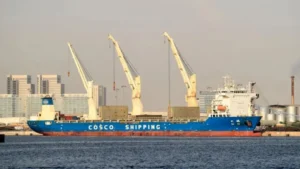
A ship docks at the Emirati port of Jebel Ali on 18 June 2020
Ahmed Alqarout reports in Middle East Eye on 23 July 2026:
The India-Middle East-Europe Economic Corridor (IMEC) has died at its Israeli end. Gulf states and their allies are now racing to build rival lines.
In June, the Saudi and Turkish transport ministers signed memoranda to revive the Ottoman-era Hejaz railway as a corridor connecting their nations via Jordan and Syria – routed deliberately around Israel. And the UAE has opened talks on a trade route from the Syrian coast through Iraq to its own Gulf ports.
And in July, DP World signed a 50-year concession with the Fujairah authorities to build two terminals on the UAE’s Arabian Sea coast, the Al-Rughailat container port among them, expressly so cargo can be landed and moved on without ever passing through the Strait of Hormuz.
Both initiatives bypass the IMEC, which was announced at the G20 summit in New Delhi in September 2023 – four weeks before the Gaza war began – and whose entire premise was Haifa as the gateway to Europe. Its backers still call it paused. But what is being built in its place sketches a regional order where trade is routed through everyone except Israel.
IMEC was Washington’s answer to China’s Belt and Road Initiative, carrying Indian goods across the sea to the UAE, overland by rail through Saudi Arabia and Jordan, and out of Haifa to Europe. Its foundation was Gulf-Israel normalisation, meant to give the Abraham Accords an economic spine.
But developments in Gaza froze the Jordanian segment before a metre of track was laid, and put the political precondition beyond reach, with the Saudis rejecting normalisation absent recognition of a Palestinian state. The current war on Iran then did to the physical vision what Gaza had done to the political one, as Israeli ports and power stations came under sustained missile and drone fire.
There was also the plain matter of size. The Haifa port handled around 1.5 million containers a year before the war – nowhere near the scale its promoters implied. Binding Gulf trade to Israel meant binding it to a country at permanent war and under-capacity.
Fault line
The Gulf powers have split along the fault line that already divided them. Saudi Arabia has spent a decade trying to make itself the point the region cannot bypass, and the war sharpened that effort.
In March, Saudi Arabia Railways launched a dedicated freight corridor over 1,700 kilometres of existing line as a direct answer to the closure of the Strait of Hormuz, linking King Abdulaziz Port, King Fahd Industrial Port and Jubail Commercial Port to the Jordanian border.