

How Israel is eroding life for Palestinians in the West Bank
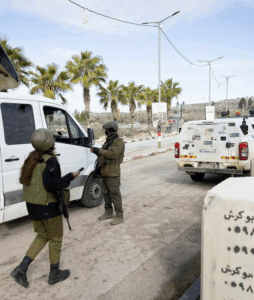
An IDF checkpoint at the exit to the Palestinian town of Turmus Ayya, in the West Bank near Ramallah
Abdaljawad Omar writes in Mondoweiss on 13 February 2026 :
Today, a quiet transformation is advancing in the West Bank. It isn’t the same spectacular form of violence that once commanded the global news cycle in Gaza, but it is more methodical and durable — and more difficult to interrupt.
It unfolds in three seemingly unrelated processes: financial warfare against Palestinian economic life, state-backed settler terror, and the legalization of annexation. What binds these processes together isn’t simply their occurrence in the same territory at the same time, but their shared architecture: they are part of a regime of compression that doesn’t outright destroy Palestinian life, but systematically constrains it.
Each mechanism operates through a different register — one through liquidity, one through violence, one through law — but all converge on the same objective: to narrow the field for Palestinian life to continue.
All of this takes place under the radar, as the world appears to be moving away from Palestine. The global movements were, after all, convoked by the horror of daily massacres, yet everything in the West Bank appears unchanging on the surface. The daily passage through checkpoints has hardened into a ritual. Over 42,000 Palestinian refugees from the camps in Jenin and Tulkarem remain displaced, inhabiting a suspended tension that refuses resolution.
As the massacres in Gaza change form and lose their most spectacular force, the movements protesting them falter, and solidarity reveals its dependence on blood and catastrophe. When horror becomes less televisable, attention disperses — a grim reflection of the state of the global attention economy.
This endless churn has done more than exhaust attention: it is laying the groundwork for other violence to proceed in the West Bank unnoticed.
This is how the Israeli regime of compression continues to erode the conditions for Palestinian existence.
Financial blockages
The West Bank is facing a severe banking and liquidity crisis driven by long-standing Israeli limits on currency exchanges under the 1994 Paris Protocol.