

How a quiet Bedouin village in Israel’s south turned Into Ben-Gvir’s supremacist playground
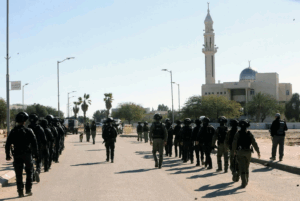
Police in Tarabin on 4 January 2026
Eden Solomon and Josh Breiner report in Haaretz on 7 January 2026:
After a week of raids, riots, arrests and protests sweeping the Bedouin community in Israel, the southern village of Tarabin was quiet Sunday, hours after the police shot dead Mohammed Hussein Tarabin al-Sana, 35. An officer at the entrance to the village announced that the police were engaging in “operational activity.”
Residents were ordered to stay home, a week into the operation that was triggered by a stolen horse. A line of police advanced toward the gate, led a boy to a police van and put him inside. The entrance to the village was opened a few minutes later as if nothing had happened, but the quiet remained.
-The police’s hard line, which worsened each day, didn’t prepare Tarabin for the shooting of al-Sana in front of his wife and children. Shortly after the incident, Tarabin residents gathered at al-Sana’s home, a few hours after they had gathered at the local farm to protest the police operation.
Officially, there is no curfew in Tarabin. Residents are free to enter, walk around and leave. But some people trying to leave find themselves arrested or fined for lacking an ID card or having a broken taillight on their car. But this time, they didn’t shout slogans. A deafening silence and a sense of helplessness replaced the shreds of hope that had sent the people out to protest.
“Tarabin has never had such a crisis,” said al-Sana’s Uncle Faiz, who couldn’t hold back his tears. “I’m scared. I’m nervous. What we saw in Gaza and the West Bank has reached us, too. It looks like organized murder.”
The face of al-Sana’s brother Ahmed, meanwhile, reflected humiliation. “They grabbed me, blindfolded me and pushed me to the ground. They didn’t say anything,” he said. “There was shooting, then Mohammed’s wife screamed, and then there was quiet again.”
Ahmed said it took half an hour for his brother’s body to be removed, and an ambulance wasn’t used. “It didn’t happen in the street or at a crime scene,” he said. “It happened at his home, in front of his children. It’s a nightmare for life.” He and the other mourners are afraid to guess where this incident will lead. “It depends on the investigations,” Ahmed said. His cousin, Mundar al-Sana, interrupted him: “You can never expect justice from a country that appoints a national security minister with a past of terrorist crimes against Arabs.”
According to Mundar, National Security Minister Itamar Ben-Gvir wants to exacerbate the situation to justify distributing weapons to civilians.
“He wants a Guardian of the Walls II to provoke us into violence, but we won’t let him have the pleasure,” Mundar said, referring to the May 2021 missile war with Gaza, which was accompanied by intercommunal violence in Israel. “We’ll operate legally. We’ll shut down intersections if necessary, but we won’t be dragged into the riots that he’s eagerly awaiting.”
Taleb al-Sana, another relative, doubted that Mundar’s plan could succeed. Taleb tried to show restraint and hope all week, but now he looked crestfallen.
“Until yesterday we still believed we could keep things quiet,” he said. “Despite the harassment, despite the tear gas. Now, I see it’s no longer in our hands. Not everybody who wants to keep to the straight and narrow can.”
Taleb noted that Saturday’s protest took place without clashes with the police, reflecting an effort to restrain the rage. “But today, the young people realized that human life has no value in this country,” he said.” You can’t stop this feeling.”
The police said that they “continue to boldly initiate widescale operations to increase security and governance, to maintain public order and strengthen the sense of security while enforcing the rule of law in Tarabin. We will continue to operate with the goal of strengthening governance and law-abiding citizens.”
Nothing to lose
On Saturday, the day before al-Sana’s shooting, the police set up a tent at the entrance to Tarabin. Next to it were patrol cars and confiscated all-terrain vehicles. Police checked everyone going in and out of the village, which looked like a war zone. Children played with empty tear-gas canisters and rubber-bullet cartridges.
At a protest of hundreds of people, a helicopter hovered above. Local council member Abed al-Sana said that the past week was a turning point. “It finally proved to me that we don’t live in a democratic country,” he said. “There’s no collective punishment in democracies. This wouldn’t happen in a Jewish town.”
He said that Tarabin, founded in 2005 after the people were relocated from a site next to the upscale town of Omer, has been abandoned. The infrastructure is broken, and there are no factories or jobs. The locals say their children grow up under the shadow of police harassment.
Abed said the police operation was a total failure; no weapons were found. “Anyone who seeks a goal in a village of 4,000 residents and attacks innocent people doesn’t reach their goals,” he said. “They just flounder and waste resources. They talk about governance, but they didn’t do anything but torment us.” Standing next to him was Alaa al-Sana, a dentist who hasn’t been to work since the operation began. “This operation only exacerbates the situation,” he said, looking at the young people. “If this policy continues, law-abiding people will realize they have nothing to lose. They’re being bunched with criminals.”
Young people were particularly vocal at the Tarabin demonstrations. Fourteen-year-old Ahmed (not his real name, as with all minors in this article), doesn’t speak Hebrew. He was arrested a week ago while walking barefoot and taken to a police station. Police took an hour to inform his parents. He was released without knowing the reason for his arrest. His friend Nur, also 14, said he was almost arrested.
“They thought I threw stones,” he said. “The police officer pushed me and told me to stop throwing stones. They repress us. It’s collective punishment.” Another teenager described how he was taken from his home and arrested. “They didn’t tell me what I was suspected of,” he said, adding that he was interrogated for three hours, the first time he had ever been questioned.
The interrogator, who told him he was from the Shin Bet security service, asked him if he knew who had torched a vehicle, who had thrown stones at the police, and if he was for or against the country. He says he was told to relay a message to the village. “Tell the residents to lower the tone. We’ve entered the picture,” he quoted the interrogator as saying. He said the interrogation upset him more than anything else. “I felt that a criminal organization was talking to me,” he recalled. “‘You’re not stronger than the state,’ they told me.”
The Shin Bet declined to comment.
Another resident said he had to report for interrogation in the middle of the night. “They told me if I didn’t come now, they’d take me out of bed,” he said. He was also questioned about torching vehicles. He said he was told “to calm spirits” among the young people. Then they showed him a video of himself, where he said: “We aren’t afraid and we don’t care about Ben-Gvir. He doesn’t scare us, even if he comes with a million cops.”
The police asked him why he said this and if he realized that other young people might interpret it as insurrection against the state. “I explained to them that I wasn’t inciting against the state; the minister was, with what he was doing in the last few days,” he said.
Marking a target
The abandoned gas station next to Tarabin became an impromptu police fortress over the past week; it was packed with dozens of patrol cars. From this site, forces entered the village in organized waves. Hundreds of police officers moved around Tarabin, while drones and helicopters hovered above. Flares lit up the sky at night.
Representatives of government companies who showed up always had a police escort. The local health clinic was closed from the start of the operation.
Officially, there is no curfew in Tarabin. Residents are free to enter, walk around and leave. But some people trying to leave find themselves arrested or fined for lacking an ID card or having a broken taillight on their car. That’s how the de facto curfew emerged. At night, residents said, patrols roamed the streets, with the police making announcements and playing loud music.
“They’re doing this on purpose,” one man said. “They made arrests near my home at 12 midnight and played ‘Am Yisrael Chai,'” a famous nationalist song.
A makeshift police headquarters was set up at the entrance to Tarabin, where the police placed riot gear. They blocked the main entrance with concrete blocks. Members of the National Guard, which was set up by the police in 2024 under Ben-Gvir, stood nearby and checked everyone entering and leaving. The Guard led the operation over the past week.
According to National Guard chief Nachshon Nagler, the police estimated that only 10 percent of Tarabin residents take part in crime. Still, the police set the operation’s goal as “increasing governance and creating friction with the population.”
Dozens of residents were arrested during the raids, including minors below the age where they would be liable for criminal punishment. Very few were suspected of arson.
On Friday, the stolen horse that set off the operation was found in a nearby Bedouin village. After the police raided Tarabin, the arsons in nearby Jewish towns began, which the police called revenge attacks. Tarabin residents said Sunday that the police operation was the revenge attack because an entire village had been punished in the name of “governance.”
Yasser, who lives near the entrance to Tarabin, said that “I feel like I’m in prison. I’m home but not I’m home. I can leave and visit my mothers and siblings, but I still feel like I’m in prison. We’ve had operations in Tarabin – lockdowns with concrete blocks, entries and exits – but never like this. It’s not enforcement, it’s harassment.”
Forces came to his home Sunday. “The police served me a demolition order for a garden shed,” he said. “They broke the gate lock and conducted a raid.” A day earlier, a drone flew above his house for 40 minutes. “They seem to be looking for somewhere to apply pressure, somewhere where there’s a problem,” he said. “They come the next day.”
The most concerning price
The most illustrative moment of the Tarabin operation may have come Tuesday, when Ben-Gvir walked through the village surrounded by dozens of police officers during the Muslim afternoon prayer. When the procession neared the mosque, the forces pushed back people looking on. Ben-Gvir stopped there for several minutes, apparently to show his presence. He went on to one of the stables, dragging along the forces and the accompanying reporters. The streets were empty. Children peeked from the windows.
Perhaps the most threatening moment of the week was Police Commissioner Danny Levy’s visit two days later. A small girl was standing in a neighbor’s yard.
Without warning, dozens of police officers, headed by the commissioner, surrounded the house and sealed off the area. The girl was trapped; no one was allowed to come to her as she faced a member of the security forces with a drawn gun. Her mother and aunts stood meters away next door, frantically calling out her name.
“When we told an officer that the girl wanted to return to her family, he answered, ‘Not now. There’s an operation at the house,'” one eyewitness recalled. The forces only relented several minutes later.
For the people of Tarabin, the most concerning price of the operation isn’t the number of arrests or violent incidents, or the loss of security. It’s the price the children are paying.
This article is reproduced in its entirety