

Here settlers show no mercy to the sheep, not even the lambs
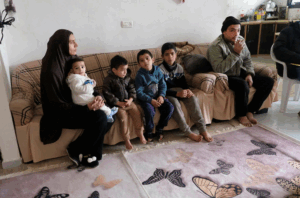
The Daramin family in their home in Samu, January 2026
Gideon Levy reports in Haaretz on 3 January 2026:
Two newborn lambs. They came into the world prematurely after their pregnant mother was attacked by settlers: They slit her neck and bashed her head with clubs. The ewe somehow survived but miscarried, and now the shepherd, Mahmoud Daramin, is trying to save her offspring.
The newborns are fragile and frightened. When the mother, separated from them after birth and now held in a pen, sees them from a distance in their plastic crate – an improvised incubator equipped with a lamp to keep them warm – she trembles.
The walls of the pen are stained with now-blackening blood of sheep that were slaughtered here mercilessly by the settler scum who have shown up at the Daramin home twice in two months to attack its inhabitants. In both assaults they pepper-sprayed the family’s children, slit the necks and smashed the skulls of the sheep, broke windows in the house and wrecked a car.
This week the parents and their children huddled around the wood-burning stove in their living room, their faces a study in terror.
On Monday, when we visited, a full-blown winter storm raged in the South Hebron Hills. A hard rain fell, the wind howled, the dirt path leading to the Daramins’ home had turned into a muddy quagmire, almost impassable; the cold was bone-chilling. The family moved nine years ago to Wadi Jakhsh, on the eastern outskirts of the town of Samu, about 12 kilometers from the city of Hebron, hoping to find wide-open spaces outside the congested town and to improve their living conditions. They had no idea they were condemning themselves to live in the shadow of terror.
Their house is in Area B of the West Bank, where the Palestinian Authority has civilian control, but who really cares? As Matan Golan reported in Haaretz this week, the Israel Defense Forces and the settlers are now also expelling Palestinians from Area B.
Two carpets with images of butterflies on them provide a semblance of relief in the bleak, bare room. At night, the family lays their mattresses down there and snuggles up around the stove, trying to stave off the bitter chill.
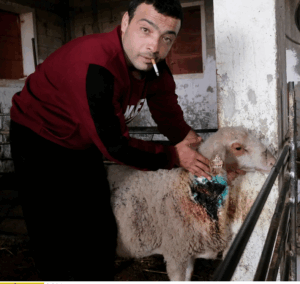
Mahmoud Daramin with an injured sheep
On our way there, Nasser Nawaj’ah, a field researcher for B’Tselem – The Israeli Information Center for Human Rights in the Occupied Territories, shows us other damage wrought by settlers in the area: Here we see the skeletons of two houses, also in Area B, whose renovations the settlers are preventing, rendering them unfit for habitation; there we see a burned-out car.
This is a land of lawlessness, only made worse after October 7. Until then the Daramin family’s life was relatively tranquil. Mahmoud, 35, tills the soil and works in a stone quarry nearby; he and his wife, Wafa, 31, have four sons: Mohammed, 7, Ahmed, 4, Saddam, 2, and 6-month-old Omri – all of them in danger in light of the incursions by their violent, uninvited neighbors. Immediately after the war broke out in Gaza, the settlers embarked a relentless campaign of abuse and harassment, preventing the Daramins from accessing the land they own near their house: 8 dunams (2 acres) of barley and wheat fields, an olive grove and pasture land. When they tried to reach their fields the settlers shot at and attacked them. A few weeks after October 7, the settlers moved into a Palestinian mobile home located next to a Palestinian-owned quarry and their shacks cropped up shortly afterward, scattered on the hill across from the Daramins, far apart from each other, the better to seize more land.
In November 2023, when the family couldn’t get to their fields, Mahmoud started to pasture his flock closer to home. The settlers’ rapid-response team, under the command of someone named Yariv Ben Elisha, who lives in some illegal outpost, told the shepherd he was not allowed to leave his house with the sheep. Mahmoud was compelled to sell his flock of 35 and to replace them with a different breed, more expensive, that is more suitable to life in a pen without grazing freely. Each sheep cost him 3,500 shekels (close to $1,000). Some would end up being slaughtered by the invaders.
About a year ago, the settlers started to approach the Daramins’ house. Sometimes in uniform, sometimes in masks, in gangs of eight or nine, they menaced the inhabitants and defiantly emptied their water container. And then came the two “big” attacks, as Mahmoud calls them, on October 27 and December 23 – twice in two months.
In the first assault they arrived at about 1 P.M. Mahmoud had just recited his midday prayers when he saw eight of them approaching. One carried a rifle, two brandished clubs and all were masked and wearing gloves. They began by smashing the windows of his Mazda 232, parked next to the house.
Mahmoud quickly locked the door but the assailants were undeterred, smashing the kitchen windows and the glass on the front door. Then they split up, some heading for the sheep pen next to the house. Footage from the security cameras Mahmoud installed after the waves of harassment began showed two settlers with clubs entering the pen and trying to pull the sheep out, probably with the intent of stealing them.
Unable to extricate the animals, they started to beat them. First they went after the lambs, which had been separated from the adults, and killed 10 of them: Six of them died instantly, four more died from their beatings a few days later, and only two survived. A settler dropped a cinder block on the head of one of the lambs, Mahmoud recalls. Then they turned to the older sheep, wounding five of them.
They tore open the flock’s fodder bags, scattering and ruining their contents, then followed suit with the animals’ medications. They set fire to the hay outside and broke one of the security cameras that filmed their pogrom.
At the same time, other gang members sprayed pepper gas into the house. Wafa and Mahmoud moved the children away from the doors and windows. Omri, the baby, gagged and coughed; everyone’s eyes burned. Mahmoud called relatives in Samu and asked them to summon an ambulance, which evacuated the youngsters to the hospital in the nearby city of Yatta. The settlers left. Their pogrom had lasted all of six or seven minutes, Mahmoud says.
A Ford Ranger – one of a fleet that Settlements Minister Orit Strock has distributed for free to settlers so they can wreak their havoc all over the occupied territories – was waiting for the rioters and quickly transported them to their getaway car, which was parked not far off, next to the quarry.
Losing no time, Mahmoud called the police, who, unbelievably, showed up quickly. They collected evidence, including footage from the security cameras that hadn’t been broken, and instructed Mahmoud to proceed to the police station in the urban settlement of Kiryat Arba, abutting Hebron, to give testimony, which he did. Quiet reigned in the weeks that followed, but the family lived in abject fear. And with good reason.
On December 23, Mahmoud came home from the quarry, said his evening prayers at 6:10 P.M., then went to sleep. Wafa helped the children with their homework before putting them to bed. By 9 P.M. everyone was asleep around the stove in the living room. At 10:30 Wafa woke up to feed Omri when suddenly she heard stray dogs barking wildly outside. Overcome by a sense of foreboding, she awakened Mahmoud, who could see by means of the security cameras seven figures approaching the house. Masked, gloved – with the usual trappings.
One unsuccessfully tried to break through the front door – whose glass had been replaced with metal plates – with an axe. The others headed to the sheep pen and again smashed a camera. Mahmoud and Wafa moved their terrified, weeping children into an unheated inner room. Mahmoud tried to block the hole in the front door with a pillow, but it didn’t help. A settler pepper-sprayed the house through the opening.
Again the family called the relatives in Samu, again an ambulance was summoned to evacuate the gasping children, again the police were called. The B’Tselem field researcher, Nawaj’ah, tells us he arrived at about 11 P.M. and saw sheep bleeding from their necks in the pen, and the police and army troops collecting evidence.
This time the darkness had prevented Mahmoud from seeing how and where the settlers fled. Once more the assault had lasted just a few minutes. In the Kiryat Arba police station, where he’d gone immediately afterward to give testimony, he recognized one of his assailants – the one who pepper-sprayed the house – who had been taken into custody. The clothes of another settler were bloodstained, he says, undoubtedly by the blood of his sheep.
An Israel Police spokesperson told Haaretz this week that the police detained four suspects, who were initially remanded in custody but were released this past Tuesday to house arrest until January 4. The police also issued a gag order concerning details of the investigation.
Meanwhile, back at home, Wafa Daramin admits she is still afraid but insists that her family will not leave. The children threw up the day after the attack and are sleeping badly, terrified by the slightest noise. Ahmed is wetting his bed. This time Omri was kept in the hospital overnight for observation. Wafa moved to her parents’ house with the others for two days until the gas in the house dissipated.
Barbed-wire rolls now lie in the yard. Mahmoud will try to further fortify his property in order, he says, to help fend off the next assault, which he says is clearly only a matter of time. In the pen the sheep move about restlessly, almost all their necks bearing deep scars.
This article is reproduced in its entirety