

Go to Qusra to see what Israel is trying to hide
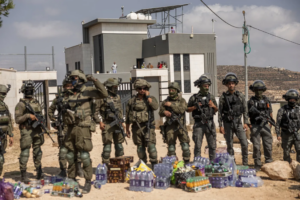
Israeli soldiers and Border Police officers standing in front of the besieged home in Qusra, behind water and food that Israeli solidarity activists attempted to deliver, 14 August 2026
Dahlia Scheindlin writes in Haaretz on 17 August 2026:
It isn’t easy to visit the families of Qusra, in the northern West Bank, whose homes have been besieged by settlers since last week. Instead of chasing away the settlers, the IDF extracted up to 20 Palestinian families, then let some back, but not all. Those who returned found their homes trashed and designated a closed military zone, still under IDF control.
The villages of this area are so close for most Israelis – just over 50 kilometers from Tel Aviv as the crow flies – but they feel like a different universe. Google Maps does not display many of the rocky, steep, switchback dirt roads there. Many streets have no names and follow no grid.
Hiding a whole population
The real reason it’s so hard to reach the besieged families or see their homes is because the Israeli authorities do not want them – or any Palestinian – to be seen.
Just getting to the villages requires navigating an intricate network of narrow dirt paths barely wide enough for a car – ideally a jeep – to reach the larger paved roads that connect the towns. But nearly all of them are blocked.
Trundling along, a mound of rust-colored rocky earth suddenly looms ahead of you, or a freshly dug ditch, a chain with a padlock or a garish yellow gate, installed after October 7 by the army. A Palestinian woman walking in the punishing midday heat with heavy robes and a basket on her head probably isn’t just practicing folksy ways, but more likely knows you can’t drive to do errands.
United Nations agencies document over 900 such barriers at present, but how can researchers keep up? The very moment we drive by, three young settlers with ostentatious hair are digging a ditch to block another road. They glare at us and claim to be repairing a water pipe, but these are no water company employees. Their looks are identical to the settlers banging stakes into the ground along other West Bank roads, paths and fields to plant endless Israeli flags.
If you’re coming from the main road where Israelis travel (Area C, under the Oslo formulation), some of the turnoffs to the Palestinian villages in this enclave of Area B are being cut off, which makes it hard to meet, see or even know about them.
After numerous such blocked roads got us twisted around and lost, we finally found a tiny dirt path not far from the settlement of Shiloh, that promised to link up with a bigger road where we could wind back to the villages. But just meters before they met, yet another insidious pile of earth suddenly materialized, dumped over the entire width of the path – almost. In a split second of lost patience and poor judgment, we skirted the mound on the leftover margin, and rolled too close to a side-ditch. The vehicle tipped dangerously, and we were stuck.
It took half an hour of standing in the sun, humbly asking passing settlers for help, before a stubbled man with a black kippah and a pistol hitched a chain to his baby tractor and pulled us out. It had taken only two hours of driving through that suffocating terrain to become frustrated and make the stupid driving move – all with the subconscious knowledge that Hebrew-speaking Israeli Jews can always get help.
Palestinians live these two hours every day, all day, all the time. If they burst a barrier or even accelerate, they may not live to write an article about it.
We finally reached the besieged home on the hills outside Qusra – deep inside Area B, where the Palestinian Authority is supposed to control civilian affairs. But the long journey there ended before it started, with three masked soldiers and two minutes of dialogue.
The soldiers sat under little white tent next to the home. They sprang up as we drove, weapons clenched, and approached the car. Their masks revealed only small glimpses of baby cheeks and acne. “How are you?” we asked. The three intoned reflexively “baruch hashem” – bless god. Their next words were also automatic: “This is a closed military zone. You’ll have to leave now.”
These encounters are ritualistic and consistent. Soldiers gave the same response a few months earlier, just ahead of the re-dedication of the settlement of Sa-Nur, as they rebuffed journalists attempting to get near.
There’s no discussion; it’s almost impossible to coax out any words beyond “leave, now” and “closed military zone.” As we turned back and drove past the house, I saw a Palestinian man on the balcony looking in our direction. We slowed; disappointment set in that yet again, there was no way communicate – and before I knew it, I was waving at the man. His face seemed to brighten, and he waved back.
The soldiers were behind us, unhappy. Their cordiality vanished, and they were rushing towards the vehicle, agitated in their facelessness, demanding to know why we had paused. We fumbled to convince them of a seat belt problem and left.
What the hidden things reveal
The house was off limits, but that just made the bigger picture clearer. First, Israeli authorities would like its West Bank policy to be like Gaza: inaccessible to eyewitnesses. Those choked-off roads in the region are not just a security measure to hinder Palestinian movement. Sealing the homes from inquisitive eyes isn’t about keeping settlers and Palestinians apart. Israel wants to hide its actions, then complain about misrepresentation.
But there’s a bigger picture still. This one, paradoxically, is plastered along the roads in enormous block-letter billboards: “MAKING HISTORY! REDEEMING AREAS A AND B” and “We embrace the heroes of the Tzofnat ranch [also in the Samaria region] – liberate the ranchers!” (the latest euphemism for the most violent Israelis destroying Palestinian lives, land and property in the area).
Add to these an election ad for the Religious Zionism Party splayed alongside the highway: “Tax benefits for Judea and Samaria residents have gone into effect – Yes. Smotrich.” This one sports a picture of Bezalel Smotrich, effectively the minister of annexation, and another party member, Tzvi Succot, who lives in Yitzhar, one of the most extreme established settlements in the West Bank.
No one is hiding the general policy of this Israeli government: Take over the land, whether by brute force or benefits and bureaucracy, and squeeze the Palestinians out.
Next, this reality should remove all doubt about a recent emerging narrative that the IDF, the Israeli state or its institutions is somehow losing control over those raucous troubled youth. While cultivating the settler militia groups might well be playing with future uncontrollable fire, that’s a long way off.
For now, be fully assured that Israel’s military, security and intelligence institutions are robust and fully capable of executing policy from above. There is no impending anarchy or state collapse here; the opposite.
Last week, Israeli authorities, together with Interpol, needed just a few days to locate a mother and daughter halfway around the world. The women tried hard to vanish from another continent a week earlier, but the authorities pinpointed their whereabouts and apprehended them on a bus driving through Argentina. Stopping at least most of the “delinquent youth” (if that’s what this was) would be child’s play: Those who commit terror are right here in the country’s backyard. We all know the names of the most prominent or deadly among them already.
But most soldiers are both fully in control and fully aligned. This goes beyond the incidents of those who join settler attacks, to the mundane duties of snatching Palestinian homes and land. Despite the hot sun, their layers of armor and masks, these soldiers seem satisfied to fulfil their task of rejecting Palestinians, Israelis and internationals – anyone who threatens the fundamentalist fiefdom, even just by witnessing it. That bottom-up enthusiasm is nurtured and embraced from the top of the Israeli political pyramid.
Most Israelis may not travel these West Bank hills, but there’s no way to hide what’s happening from ourselves.
This article is reproduced in its entirety