

From the age of catastrophe to the age of hope: Why a free Palestine matters to the world
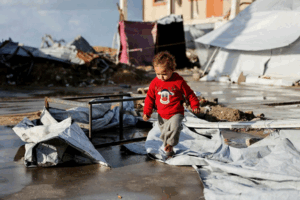
A barefooted displaced Palestinian toddler walks in a refugee camp in Gaza City on 28 December 2025
Ilan Pappé writes in The Palestine Chronicle on 2 February 2026:
This piece is written on International Holocaust Remembrance Day. My parents, German Jews, lost members of their families in that terrible chapter of Nazi genocide. From that position, I found Tony Blair’s initiative in launching this date a cunning and dishonest approach to endorsing the Zionist manipulation of Holocaust memorialization.
But interestingly, in Israel, there is very little reference to this day, apart from repeating the allegation that opposing the genocide of the Palestinians is a new form of antisemitism.
Israel prefers a day of remembrance that it controls exclusively, and which conveys the twin messages that Zionism is the only guarantee against another Holocaust, and that the Palestinians and their allies are the new Nazis threatening Western civilization. Moreover, Israel refuses to universalize the Holocaust, claiming it cannot be compared to genocides that preceded it and those that followed it.
Today, however, anti-Zionist Jews all over the world offer an alternative Jewish remembrance of the Holocaust. They remember all genocides and boldly point to a much wider context in which mass killings of any group in modern history should be discussed. They insist that all genocides should be analyzed as equally crucial for better understanding the human-made catastrophes that plagued the world, ironically, in the age of enlightenment, modernization, and progress—the age we are still living in.
Holocaust Memory, Zionism, and the Age of Catastrophe
The recent violence of the West and its allies, spreading now from the killing fields of Gaza to the American threats against Venezuela and Cuba, brings to mind Eric Hobsbawm’s seminal book, The Age of Extremes: The Short Twentieth Century (1914–1991).
This book begins with the Age of Catastrophe (1914–1945) and ends with a very pessimistic view of the ability of the world to extract itself from the awful years of catastrophe that were Western-made and raged mainly in the West.
Hobsbawm concluded his book with the following warning:
“If humanity is to have a recognizable future, it cannot be by prolonging the past or the present. If we try to build the third millennium on that basis, we shall fail. And the price of failure, that is to say, the alternative to a changed society, is darkness (585).”
Indeed, if the Age of Catastrophe is re-emerging globally, or in Palestine, Hobsbawm’s gloom will be validated, and “the price of failure,” as he calls it, will be paid by the Palestinians.
Only in a very short reference does Hobsbawm include Zionism as one of the extreme phenomena of that age. The worst phenomenon of that age was Nazism. Jewish activists such as the late John Rose paid attention to the fact that Zionism was born in an age of extremes, as was Nazism.
Rose wrote:
“Zionism is not the same as Nazism. It did not have an exterminationist intention at its core, though, as we shall see, Zionism has been, and is, capable of genocidal outbursts. But Zionism is rooted in the traditions of European imperialism. That truth alone is sufficient to serve urgent warnings about the implications of Zionism’s ruthless colonial ambitions in Palestine.”