

EU announces billion-dollar Gaza aid package designated for ‘recovery’ projects
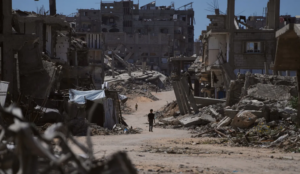
A Palestinian child walks along a street surrounded by buildings destroyed in Israeli military strikes in Khan Younis in July 2026
Liza Rozovsky reports in Haaretz on 13 July 2026:
The European Union-led Palestine Donor Group announced Monday that it had raised almost 900 million euros (about $1 billion) in aid funds for the Gaza Strip.
Convening in Brussels, European Commission President Ursula von der Leyen said the aid package, called the “Team Gaza Initiative,” would finance “early recovery” projects as part of an intermediate phase between immediate humanitarian assistance and long-term reconstruction.
The PDG aims to foster basic living conditions, clear debris and restore essential services such as water, electricity and medical infrastructure.
Notably, official EU sources said that European Commissioner for the Mediterranean Dubravka Šuica reached an agreement with Foreign Minister Gideon Sa’ar that would allow two major reconstruction projects in Gaza to advance. However, Sa’ar’s office stressed these were not reconstruction projects but rather “humanitarian projects,” while EU officials insist that the initiatives are not merely humanitarian. They expressed hope that implementation would begin soon after a brief coordination process with the Israeli authorities, primarily the Coordinator of Government Activities in the Territories (COGAT).
From the European Union’s perspective, the meeting is a demonstration of strength that allows it to exercise its influence over the Israeli-Palestinian conflict and developments in Gaza and the West Bank. The meeting places the Palestinian Authority at the forefront as the sole legitimate representative of the Palestinian people in the European view. It also allows the EU to bring together rival actors on the diplomatic stage and compel them, at least for appearances’ sake, to cooperate.
On the sidelines of the PDG’s conference in Brussels, the EU and several European nations agreed to provide nearly 42 million euros in additional funding to the Palestinian Authority. The approved funds come in addition to nearly 310 million euros that the European Commission committed to provide to the PA at the first PDG meeting in November.
How the funds are distributed remains an open question. Sources stressed that the money will not be transferred directly into the Gaza Board of Peace’s bank accounts. They noted, however, that the contribution falls under UN Security Council Resolution 2803, which enabled the establishment of the Board of Peace and endorsed Trump’s Gaza plan.
A diplomatic source said the European Union had effectively agreed to integrate into the operational framework surrounding the Board of Peace, describing this as a significant achievement for the organization. This is also because Trump’s ambition to turn the council into a kind of alternative to the United Nations has made it difficult for Western countries and the European Union to cooperate with it fully.
“What matters is that the partners, including the United Nations, begin the early recovery process,” EU sources said. Several UN agencies operate in Gaza, including the World Health Organization (WHO) and the World Food Programme (WFP).
But UNRWA has been, and remains, the organization with the greatest operational capabilities. This is despite the extensive campaign waged by Israel and the United States against the agency. In June, the organization stated its financial situation is untenable, putting the viability of its operations at stake.
With thousands of employees deployed throughout Gaza, UNRWA is still considered the organization best equipped to carry out projects on the ground, including water supply and garbage removal projects, as dangerous quantities of waste accumulated across Gaza during the months of war and since the cease-fire was declared.
The Board of Peace will benefit from Europe’s financial backing, even if its technocratic committee assumes a partial or symbolic role over the funds’ management. The board is suffering from a severe cash shortage, seriously impairing its ability to operate. The funding shortfall was also highlighted in an official report that the Board of Peace submitted to the UN Security Council in May.
In Brussels, officials attending the conference are the High Representative of the Gaza Board of Peace, Nickolay Mladenov; Ali Shaath, chairman of the Palestinian National Committee for the Administration of Gaza; and Aryeh Lightstone, senior adviser to the Board of Peace, who also serves as the White House representative responsible for implementing Trump’s 20-point plan for Gaza.
They are joined by Christian Saunders, head of UNRWA; Israeli and Trump administration officials have sought to minimize his influence in Gaza.
Representatives of Gulf states, which pledged to finance Board of Peace activities, are also participating in the donors’ meeting. The European Union hopes the conference will help unlock the transfer of funds, but at this stage, no breakthrough appears imminent. This is due in part to continued fighting in the Persian Gulf and the Gulf states’ dissatisfaction with Israel’s policy in the Gaza Strip.
In addition, the EU announced that it would contribute more than 40 million euros to the Palestinian Authority for basic needs such as paying salaries and providing civilian services; the contribution was cosigned by Spain, Denmark, Cyprus, Ireland, Greece, Portugal, Italy, the Netherlands, France, Switzerland and Belgium.
The funds will be transferred through the EU’s PEGASE mechanism, which has provided financial assistance to the Palestinian Authority since 2008. This amount is in addition to the 310 million that the European Commission has already committed to transfer through PEGASE during 2026–2027. In effect, the mechanism serves as an economic lifeline that has enabled the Palestinian Authority to survive since Israeli Finance Minister Bezalel Smotrich decided to halt the transfer of Palestinian tax revenues – estimated at around 14 billion shekels ($4.8 billion), which legally belongs to the Palestinian Authority.
Another key issue to be discussed in Brussels is the Palestinian Authority’s welfare payment mechanism for security prisoners and their families. Israel argues that despite reforms announced by the Palestinian Authority, it continues to transfer hundreds of millions of shekels to security prisoners and to the families of militants who were killed. Ahead of the meeting, the Palestinian Authority announced that an independent external audit of its welfare system had been completed, confirming that it operates with integrity.
The audit was overseen by the LLC Alvarez & Marsal, which, according to the Palestinian Authority, is an independent U.S.-based company that specializes, among other things, in corporate restructuring.
The firm concluded that the Palestinian Authority does not make payments to militants or their families beyond what they are entitled to based on their economic circumstances. “The assistance is not linked to martyrs, detainees, prisoners or the wounded, and eligibility is determined solely according to criteria that have been shown to be related to poverty,” the Palestinian Authority said.
The European Union has commissioned an additional review by a British company, which is expected to be completed within the next few months. Its findings may provide the basis for resolving the dispute over the Palestinian Authority’s payment mechanism – an issue that also underpins Israel’s decision to withhold the transfer of Palestinian tax revenues.
This article is reproduced in its entirety