

Does Gaza’s international stabilisation force have a future?
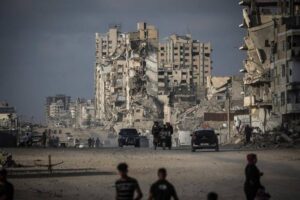
Palestinians walk along a road in Gaza City on 3 July 2026
Mohamed Solaimane reports in The New Arab on 1 July 2026:
US envoy Steve Witkoff announced Phase 2 of the Gaza ceasefire in January 2026. The plan on paper detailed how Israeli forces would begin withdrawing, an International Stabilisation Force (ISF) would move in to fill the security vacuum, and a Palestinian technocratic committee would take over civilian governance.
Five months later, none of that has happened. Negotiations remain deadlocked over Hamas disarmament; Israel refuses to advance without visible progress on that condition; and Hamas rejects disarmament as a precondition for anything. The National Committee for the Administration of Gaza does not govern in Gaza.
Washington has formally approached roughly 70 countries to contribute troops, aiming for 10,000 by the end of 2026. At its February peak, the Board of Peace meeting in Washington saw 40 countries attend and roughly $17 billion pledged. Only five – Indonesia, Morocco, Kazakhstan, Kosovo, and Albania – committed actual troops.
But support for the ISF has been faltering. The clearest case is Indonesia, which had made the largest single troop commitment, up to 8,000 personnel, and was to serve as the force’s deputy commander.
Foreign Minister Sugiono announced a full suspension of all participation discussions, citing the military escalation in the region and the shift in international attention toward the consequences of the US-Iran conflict.
The most concrete sign of forward movement came on 5 June, when the Board of Peace announced Egypt’s commitment to the ISF, posting photos of an Egyptian officer receiving the force’s insignia. Egypt had already established a command centre for the force in El Arish in December, making it the natural anchor for any eventual deployment given its shared border with Gaza.
In late June, a Hamas delegation led by Zaher Jabarin arrived in Cairo for talks with Egyptian officials and mediators, alongside representatives of other Palestinian factions. Analysts say the Cairo talks and Egypt’s recent commitment to the force suggest the international community is trying to build momentum around the ISF without waiting for the core political deadlock to resolve itself first.
Observers, however, point to the fact that how this new reality gets built, who it serves, and what it asks Palestinians to accept in exchange for a reduction in immediate violence are questions that no official statement has yet answered.
Groundwork, not deployment
Conflict researcher Said Abu Rahma says he is cautious about what the current positioning means. “What is visible now is that the full deployment of thousands of soldiers requires three conditions that remain unmet, and these are a clear political agreement, a defined legal mandate, and security guarantees from all parties. None of those exists,” he told The New Arab.