After more than two years, the US president finally unveiled his proposal on Tuesday. What is proposed exactly and what remains unclear?
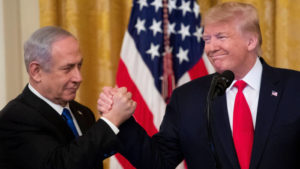
Benjamin Netanyahu and Donald Trump at peace plan announcement
Chloé Benoist, Mohamed Hassan and Daniel Hilton write in Middle East Eye:
After a two-year wait for Donald Trump’s Middle East plan to address the Israel-Palestine conflict – framed by the businessman-turned-president as a deal – we now know what it contains. Middle East Eye deconstructs the 181-page plan here to give you a broad sense of what it proposes along with lingering questions over exactly how it plans to attain those aims. We’ll be adding to this as we scour the deal.
1. Israeli annexation
Most importantly – and controversially – Trump’s plan accepts Israeli calls to annex the Jordan Valley and Israeli settlements in the occupied West Bank. To be clear, these areas are currently under military occupation by Israel and the construction of settlements there is in violation of international law. In exchange, the plan seems to offer Palestinians areas of land along the western border of Israel, connected to the Gaza Strip, as well as current pockets of territory that the Palestinian Authority controls. The plan also outlines a four-year freeze on Israeli settlement construction in the areas outlined for Palestinians. But what it doesn’t address are the many roads, checkpoints and military outposts that Israel has set up that strangle this existing territory.
2. Jerusalem
All parts of occupied East Jerusalem that lie west of Israel’s separation barrier – which has also been deemed illegal by the International Court of Justice – would be recognised as part of Israel’s undivided capital under this plan. These include large parts of the city where more than 300,000 Palestinians live, the Old City and holy sites, including the Al-Aqsa Mosque compound.
What’s left – the areas to the east and the north of the barrier – would become available for the capital of a future Palestinian state, according to the plan. The plan suggests that a Palestinian capital be cobbled together between the existing village of Abu Dis, and the East Jerusalem neighbourhoods of Shuafat and Kafr Aqab – a capital that “could be named Al Quds or another name as determined by the State of Palestine”. The Arabic name for Jerusalem, Al-Quds, translates to “the Holy City” – yet there are no significant religious sites in the areas suggested by the plan as a basis for the new capital.
3. A Palestinian state?
But when would this Palestinian state be established? The plan says this can only happen when Palestinian leadership wholly accepts Israel’s new borders, disarms completely, removes Hamas from power in Gaza and agrees to Israeli security oversight on all of its territories until a point in the future deemed ripe for withdrawal.
At this point – and only at this point – the Palestinians would receive $50bn of investment promised by the US, although even then the figure is misleading. As outlined in the economic part of the plan released in June, only $27.8bn of that will go directly to the new Palestinian state over the span of 10 years, while the remainder will go to neighbouring states.
That $27.8bn is around 27 percent less than the $38bn ten-year military aid deal that the US made with Israel in 2016.
4. No right of return for refugees
More ….