

Centralized, coordinated, brazen: the dangerous transformation of the hilltop youth
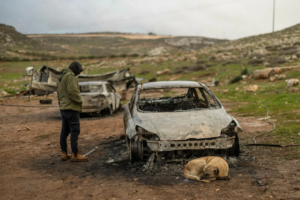
Vehicles set on fire in the village of Mukhmas in January 2026
Idan Yaron writes in Haaretz on 5 March 2026:
The SUV speeds closer. Four masked Jewish assailants quickly leap out. They jump from the vehicle, clubs in hand, and move toward the camera. The blows begin at once. The woman filming pleads – “Help, no, no, please, no!” – but it makes no difference. They beat her mercilessly and brutally attack another man, drawing blood. Even after both collapse, the assault continues, while the attackers demand: “Where are the Arabs?”
The incident took place last weekend in Qusra, in the West Bank. This time the victims were Jews, left-wing activists, but it was only a glimpse of a quickly changing reality. The “hilltop and farm youth” (the latter element being most dominant today) are shedding their skin – or at least exposing their dark nature. Developments in recent years, intensified after Hamas’ October 7 massacre, are starkly visible against the backdrop of the war with Iran.
The emerging leaders of the violent settler movement, who once preferred to operate under the radar, have in recent years embraced digital platforms and thrust themselves into the open. They have launched an amplified campaign steeped in hatred, killing and destruction. On social media they openly call for expanding the war with Iran to all fronts, urge people “not to take their eyes off Judea and Samaria,” and implore followers to “eradicate the evil from the face of the earth.” They say it outright: “If we don’t seize the opportunity to expel them now, they will go on sitting and planning how to kill as many Jews as possible.” Most alarmingly, it appears there are those – in high echelons – who respond to their poisonous message.
Contrary to common perception, the so-called hilltop and farm youth never operated as an unruly mob. Their activity was always grounded in a coherent ideology, not random hooliganism. Nor was it uncontrolled. They did not function as an anonymous crowd without responsible parties. As a sociologist, I am well acquainted with the Italian thinker Antonio Gramsci, who argued that no social movement is ever truly spontaneous. Even those that appear to be are in fact led by committed activists with a history of deep engagement with their core aims.
A few years ago, the phenomenon struck me as amorphous and diffuse. I saw the hilltop youth as a social movement built on compartmentalized “hills” – isolated cells with little direct communication, no clear hierarchy and no formal command structure. In that sense it resembled decentralized movements such as Islamic Jihad networks operating in the West, which have posed real challenges to authorities. It seemed spontaneous and apolitical, a form of leaderless resistance – a concept developed in the United States by an intelligence officer, Col. Ulius Louis Amoss, and later refined by the neofascist leader Louis Beam.
In recent years, especially since October 7, I’ve come to realize that the hilltop and farm youth have undergone a genuine transformation. From a shapeless, diffuse structure whose strength lay in its resilience, the movement has begun consolidating into a more institutional organization. In place of an absence of leadership, a kind of virtual leadership has emerged – and, as I see it, one with tangible, real-world influence.
Still, it does not operate as a formal organization in the sense described by Max Weber – one governed by legitimate authority exercised through explicit norms and defined offices. If it resembles such an organization at all, it is mainly in its sense of Politik als Beruf (politics as vocation): the expectation that activists devote their full energies to shared goals.
This evolution has been accompanied by two key trends on the ground. First, the hilltop and farm youth – albeit belatedly – have embraced digital communication technologies, from mobile phones to online networks. Second, the movement has grown more centralized and hierarchical, even if it still lacks a genuine supervisory bureaucracy.
Until recently, their use of digital tools was relatively limited. That stemmed not only from technical or operational considerations, but also – perhaps chiefly – from values and principles. Many activists believed such tools distracted them from their primary duties: Torah study and the observance of commandments, foremost among them the commandment to settle the Land of Israel. Over time, however, the importance of the internet in general, and social media in particular, became clear. These platforms were understood to complement and reinforce – even if not to replace – face-to-face interaction. Without them, a movement like the hilltop and farm youth would likely have dispersed, lacking mechanisms of coordination and control.
Today their communications network – from leading figures to the last activist or “foot soldier” in the field – appears far more integrated and coordinated, even if it remains widespread and complex. The internet and social media have paved the way for networked organizations; in business contexts these tend to be more decentralized and less hierarchical, but in the case at hand they are more structured and organized than in the past. A striking example is the U.S. far-right “alt-right” movement, which in some respects resembles the hilltop youth. Under such conditions, a small number of highly motivated activists can disseminate extreme messages, enabling the emergence of local – and at times even global – terrorist cells.
This phenomenon was previously described in the context of Palestinian “lone wolf” terrorism, in an article by Eric Barbing (Harris) and Or Glick. Through computers and mobile phones, young people connect to platforms that allow them to communicate and share files – messages, videos, images and location data. For many young people worldwide, particularly Palestinians, this is almost their exclusive mode of communication, through which they sustain operational ties, plan attacks and even declare their intent to carry them out.
Deployed in the area and equipped with mobile phones and recording devices, hilltop and farm youth activists have in recent years become a kind of forward-acting unit for the settlement enterprise. Positioned at direct friction interfaces with Palestinians and Bedouin communities, they report any perceived opportunity for harassment, repression, dispossession or expulsion. Satellite phones are installed at the agricultural farms-outposts from which the shepherd youths operate. Those on-site receive real-time updates and feed social media and relevant central (responsible) bodies with intelligence. When trouble arises, reinforcements are summoned quickly, and a local clash can rapidly escalate into a large, charged and violent confrontation, sometimes with deadly results.
On social media, a distinct leadership layer is taking shape. Even on platforms perceived as horizontal and egalitarian, soft leaders operate in practice: a relatively small group of energetic, influential and well-connected activists who exercise considerable control over the flow of information. This control is not institutional but rests on unequal distributions of social capital online. Those with greater online presence attract larger audiences, enjoy higher levels of trust and exert influence that is not only horizontal but also vertical. Prominent activists thus become influencers. Figures such as Elisha Yered, Elhanan Gruner, Meir Ettinger and Ariel Danino maintain X accounts and use them to engage with the secular-liberal public in an effort to explain and justify their actions, goals and means.
Beyond this, distinctive “nodes” are emerging online. Particularly important nodes that both channel and absorb information are known as super-nodes. In the West Bank they are sometimes referred to as security dispatchers or operations rooms. A central super-node is the news platform HaKol HaYehudi (The Jewish Voice, in Hebrew), founded in 2009 by a group from the Yitzhar settlement associated with followers of Yitzchak Ginsburgh, an American-born Israeli rabbi affiliated with the Chabad movement. The initiative evolved into an independent media organization funded by donations. With the outbreak of the Gaza war, its investigative desk expanded, as did the number of volunteers operating what they described as an “intelligence operations room,” tasked with collecting information from Arab networks and passing it to security authorities.
Another super-node is the activist group that coalesced around the Nilhamim Al Hahaim (Fighting for Life) Headquarters, which openly incite to violent extremism and even encourages vigilante terrorism. Its Telegram channel states that it aims to provide mental and security backing to the residents of Israel in general, and Judea and Samaria in particular,” with an emphasis on “protecting open areas, monitoring Arab incitement and suspicious Arab movement.” Another example is what is called the Struggle Channel group, which shares Palestinian reports of so-called price-tag (retaliatory) attacks carried out by “joyful Jews” and of “Jewish takeover of territory.”
The Spanish sociologist Paolo Gerbaudo has argued that digital communication technologies transform how social movements communicate internally and externally, as well as how they recruit and organize activists. He notes that the rise of radical and extreme right-wing movements in many Western countries has been accompanied by their growing centrality online. The combination of these two trends – the adoption of digital communication and the parallel shift in organizational structure – has exposed much of the movement’s skeleton, including its backbone. As described by Ori Brafman, who writes about decentralized leadership and network empowerment, the hilltop and farm youth have begun to behave more like a “spider” than a “starfish.”
In this sense, the new reality brings the movement closer to an underground model. The hilltop and farm youth have long felt an affinity with the pre-state Jewish undergrounds, especially Lehi (the militant Fighters for the Freedom of Israel). Yet they have avoided replicating their operational patterns. Above all, they internalized the lessons of the radical right-wing fundamentalist organization, the Jewish Underground, of the late 1970s and early ’80s, understanding that overt organizing vis-à-vis the authorities is undesirable.
These insights were reflected in documents drafted by movement leaders. In a June 2012 paper titled “A Practical Plan to Save the Outposts and the Hills in the Holy Land,” it was stated that “leadership in times of struggle is actually detrimental.” A 2013 document, “For Revolt 2,” was even more explicit: “Unlike a revolt based on an underground or an organization, the intention here is not a structured body managing the activity.” The authors added that “there are many reasons for this,” and that “it is enough to note that the current situation does not permit such an organization to survive.” Accordingly, an earlier document, “For Revolt 1,” emphasized that “the role of the revolt’s leadership (if such exists) is limited to supporting activity, publicizing it and creating appropriate resonance and public-intellectual backing as needed.”
Beam, the neofascist, who developed the concept of “leaderless resistance,” understood that the central government’s greatest fear is not a single hierarchical organization but thousands of small phantom cells acting against it. Such a situation is a nightmare for counterintelligence, as it provides no fulcrum through which to strike at the core. Even if one or several cells are exposed and neutralized, the broader network remains largely intact.
Beam also warned that processes of institutionalization and consolidation into command-and-control structures are particularly dangerous in technologically advanced societies – such as a high-tech state like Israel – where resistance organizations become easy targets for intelligence penetration. The risk increases in dense networks with numerous sustained mutual connections, which can be analyzed to extract information about meaningful patterns.
Beyond the obvious advantages of digital tools, there are significant drawbacks. Internet use in general, and social media in particular, generates digital signatures – records, likes, comments, audio clips and technical data related to time and location. Their accumulation creates patterns that can expose both the static structure of a virtual network and its dynamics, as well as the real-world phenomenon it reflects. Monitoring based on social network analysis, location and usage data, and structural mapping can identify leaders and activists, and uncover additional cells and groups. Super-nodes such as HaKol HaYehudi or Nilhamim Al Hahaim Headquarters are especially vulnerable, since much communication flows through them. Such nodes are more exposed today than ever before.
At the same time, a vacuum on the ground – while security and law enforcement authorities turn a blind eye to violence by hilltop and farm youth against Palestinians and Bedouin – has strengthened these groups’ sense that they are on a roll. This feeling was amplified after some settlers began celebrating them as avant-garde. Such dynamics almost inevitably breed complacency.
These manifestations – including graffiti claiming acts of arson and vandalism for the “King’s Battalions,” portrayed as quasi-militias, and openly boasting of violent and terrorist acts – increasingly expose the movement and its spokespeople. The consequences of this complacency and overexposure may become fully apparent in the foreseeable future, if not sooner, depending on the political and social circumstances that unfold in the state. When Mao Zedong declared “let a hundred flowers bloom,” he later explained that he intended to entice snakes out of their lairs and to get them to raise their heads – so they could then be crushed. Those who raise their heads would do well to remember this historical lesson – unless they will be condemned to repeat it.
Idan Yaron, Ph.D., is a sociologist and social anthropologist specializing in the far-right in Israel
This article is reproduced in its entirety