

As a Palestinian father struggled to save one son, a uniformed settler shot his other son too
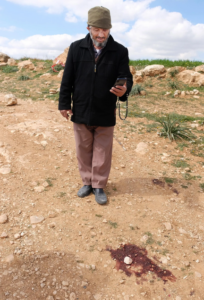
Mohammed Shnaran takes a photo of the bloodstains remaining after his son Amir Shnaran was killed on 7 March 2026
Gideon Levy reports in Haaretz on 14 March 2026
The bloodstains are still fresh, glistening pools on a dirt trail, not yet dried out by the sun. The father fixes his gaze on the reddish spots, as if taking a mental picture of his son’s blood in order to perpetuate his memory. He shifts uneasily, this way and that, clearly distraught.
Two days have passed since one of his sons was shot to death here, before his eyes, and another was seriously wounded. This is the first time the farmer has returned to the killing field. A sea of barley plants sway in the wind; some of them are trampled, evidence of the violent struggle that played out here last Saturday afternoon.
These are the fields of the village of Wadi al-Rahim in the beleaguered Masafer Yatta area of the South Hebron Hills, a tiny village of 200 souls.
Mohammed Shnaran is a 57-year-old farmer who has six children, including his deceased son. A bandage on his forehead above his left eye and stitches in his head are testimony to what happened. He’s the father of Amir Shnaran, 29, married with two daughters, who was killed here two days before our visit, and also of another married son, Khaled, 34, who was seriously wounded.
This week Khaled was still hospitalized, unconscious, in intensive care at Al-Ahli Hospital in Hebron. His physicians said that the bullet fired by a uniformed settler struck his spine and warned that he might be permanently paralyzed in both legs.
Saturday was a beautiful day. The father and his sons were in their homes. L., a settler who’s familiar from previous incidents, drove toward Wadi al-Rahim in his Ranger, a gift to progromists like himself from Settlement Minister Orit Strock. After a few attempts to intimidate and show off with his vehicle he left – but returned after midday. He chased away the shepherd brothers Falah and Abed Shnaran, relatives of Mohammed, who were pasturing their flocks on family-owned fields. And L. also attacked Abed’s 14-year-old son, Mohammed – who managed to get away – and taunted and drove away the sheep by driving near them.
This is privately owned land, located in Area B (under Palestinian administrative control), but who, other than the Palestinians, even cares about that these days?
After L. left, N. – another notorious settler-neighbor, from the farm located on the ancient site of Susya – arrived in his own off-road vehicle, raising dust and creating a disturbance, before driving off.
It seems that everyone knows everyone here: The assailants know their victims, the victims know the assailants. After a few minutes, the Ranger also returned to the wadi that separates two violent settler outposts from Wadi al-Rahim.
At 3:50 P.M., N. returned with a herd of cows that entered the Shnaran family’s barley field. The farmers had plowed, sown and cultivated the crop for months, and now the cattle were chomping and stomping on it. “Get out of here, get out of here!” the men shouted. But the settler ignored them, we are told now, and continued with his “pirate pasturing,” acting as if it was his land and he could do whatever he wished. Mohammed, who saw what was going on, immediately phoned the police, but there was no answer.
Six or seven men from the family went out to expel the intruders. Among them were Mohammed and his sons Amir and Khaled, along with their uncle and cousins. Mohammed filmed the marauding N., who then attacked him and smashed his phone on the ground. He adds that the settler also punched him in the face using brass knuckles, and that he fell down but then got to his feet quickly, bleeding from his forehead. The settler went on pummeling Mohammed, who protected himself with a stick. This week settlers posted a clip in which Mohammed, who is seen to be bleeding, appears to hit someone off-screen with a stick.
N. then called the police and summoned reinforcements – two brothers known for their violence, one of them wearing an army uniform. Their all-terrain vehicle was also a gift from Strock – in other words, it’s a civilian vehicle.
An eyewitness, Khares Shnaran, an 18-year-old relative, related this week that one of the two violent settlers attacked Khares’ own brother, Zakariya, 23, striking him in the face with a rifle butt. The settler in uniform fired a bullet into the air, according to other people who were there. In the meantime, his brother clubbed Mohammed, knocking him to the ground. Amir rushed to help his father, whereupon the settler in uniform fired two shots at the young man from a distance of a few meters; they hit his neck and chest, killing him instantly. Mohammed leaped up and frantically shook Amir, but to no avail. He wasn’t breathing and had no pulse. Blood streamed from his nose, mouth and ears.
Even as Mohammed was fruitlessly trying to revive his son, another shot was heard and he saw his other son, Khaled, collapse, after being shot in the right side of his chest – again from a distance of a few meters, again by the uniformed settler.
The mendacious video clip disseminated by the settlers is captioned: “Brutal lynch of a Jewish shepherd in Sussia on Shabbat – a soldier who was nearby shot one of the rioters to death.” That’s how perpetrators who make themselves out to be the victims – those who carried out the “lynching” with their own hands – described what happened when they invaded Palestinian property, letting their livestock feed on and destroy crops.
The IDF Spokesperson provided this response: “On Saturday, IDF troops, police from the Shai [Samaria and Judea] District and Border Police rushed to an area close to the village of Sussia in the wake of a report about violent friction between Israeli civilians and a number of Palestinians, as a result of which a number of those involved were wounded.
“From an initial investigation of the event,” the statement continues, “[it emerges that] an IDF soldier in the reserves who rushed to the site in the wake of a report about an attack, opened fire. The claim that two Palestinians were hit by gunfire and that one later died of his wounds, is known. IDF troops, police officers from the Hebron station and forensic investigators of the Shai District are investigating the event and collecting evidence. In the wake of the incident an investigation by the Military Police Criminal Investigation Division was launched, whose findings will be forwarded for examination by the military prosecution.”
The forces rushed in; the “claim” about a death is known.
They lay four or five meters from each other, brother next to brother, one dead, the other seriously wounded, their shocked and wounded father standing over them. When Mohammed grasped that Amir was dead, he went over to Khaled, whom he realized was still alive, crying in pain.
Private cars from the village sped the two brothers to a clinic in Yatta, where Amir was pronounced dead. Khaled was then evacuated by ambulance to Al-Ahli Hospital. Khares, the eyewitness, told us this week that settlers tried to block the cars that carried Amir and Khaled with their vehicles, but the Palestinian drivers managed to elude them.
This wasn’t the first time Amir was the victim of an attack. About a year ago, says Nasser Nawaj’ah, a field researcher for B’Tselem – The Israeli Information Center for Human Rights in the Occupied Territories, another familiar settler from a different farm-outpost set upon Amir while he was pasturing his flocks. He was wounded and taken to hospital for treatment.
Villagers tell us that settlers show up every day to graze their animals and to provoke and assault the Palestinian inhabitants. The skeleton of a burned-out car on the way to the village is also apparently a testimony to their deeds.
Last Sunday, the day after Amir was killed, Nawaj’ah relates, the brother of the shooter who joined him in the deadly rampage, appeared on the outskirts of the village, not far from the killing field, together with some soldiers and a backhoe that belongs to an earthworks company he owns. Under the army’s protection work was carried out at the site, which, according to Nawaj’ah, is intended to facilitate trespassing of neighboring Palestinian-owned fields. Says Nawaj’ah: “Yesterday there was a murder here – and the next day the murderer’s brother shows up with the army?”
While the farmers were tending to the victims, he adds, the settlers who had arrived earlier with their cattle remained in the barley field with N., as if to say: Nothing will move us from there, from the land we covet, even if it is saturated with blood.
Now all that remain are the bloodstains, the Israel Police tape around the site, the trampled barley and the blossoming swaths of spring flowers – yellow carpets of mustard plants. Mohammed, the grieving father, is agitated, wanting only to run away from the scene.
This article is reproduced in its entirety