

Can Standing Together bear the weight of its contradictions?
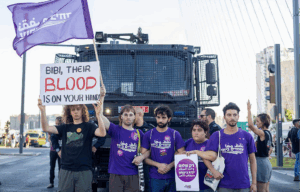
Activists from Standing Together block a police truck at the entrance to Jerusalem during a protest against the war in Gaza following Hamas’ execution of six Israeli hostages, 1 September 2024
Samah Watad writes in +972 on 19 December 2025:
At the entrance to Haifa’s International Convention Center, bereaved Palestinian families sat in silence holding portraits of their children killed as a result of the spiraling criminal violence plaguing Arab communities in Israel. Meanwhile, a few meters away, young Israeli activists handed out stickers bearing slogans that were buoyant and even hopeful, such as “Only together we can,” and “Let’s build power together.”
The contrast was disorienting. Grief, optimism, and ideological fervor coexisted uneasily at the convention marking 10 years since the establishment of Standing Together in late November.
Founded by members of the Israeli Communist Party, including former Knesset member Dov Khenin and the organization’s current national co-director Alon-Lee Green, Standing Together positions itself as a grassroots Jewish-Arab movement built on street-level organizing, bilingual messaging, and coordinated mass action that aspires to reconstitute the long-stagnant Israeli left. Having grown steadily during its first eight years, the movement’s visibility has skyrocketed amid Israel’s genocidal war on Gaza, which has brought renewed scrutiny both locally and internationally over its role in the struggle for a just future in Israel-Palestine.
Standing Together’s rapid expansion over the past two years — the movement now boasts almost 6,000 members, and its website lists nearly 80 employees — has been fueled in part by its growing appeal among young Palestinians in Israel who are disillusioned with traditional party politics. But as the movement grows, so do questions about its electoral ambitions, its stance on thorny issues like Zionism and Israel’s Jewish character, and its capacity to meaningfully engage the contradictions facing Palestinian citizens of Israel under an increasingly fascist Israeli government.
A vehicle for action
To understand the movement’s recent surge in popularity, you first need to understand the uniquely fraught position that Palestinian citizens of Israel found themselves in during the war.