

Can left-wing religious US Jews admit the experiment in Jewish power ‘is not going well’?
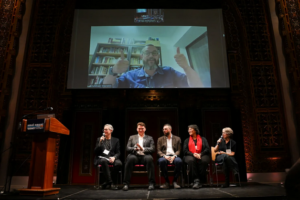
Rabbi Mikhael Manekin joining a panel remotely from Israel during the New York Smul Emuni conference, March 2026
Etan Nechin reports from New York in Haaretz on 10 March 2026:
The conference of Smol Emuni, the group of religiously observant Jews who are sharply critical of Israeli policy toward Palestinians, took place as planned on Sunday at Manhattan’s Bnei Jeshurun Synagogue – albeit without six Israeli speakers who were unable to travel due to the U.S.-Israeli war with Iran.
Organizers rushed to fill in the empty slots, making last-minute arrangements so that some of the speakers could join by video call. They even had speakers send recordings ahead of time should they be inside a shelter at the time of the conference.
In a recorded message, Reform rabbi and Democrats MK Gilad Kariv voiced his party’s objection to the war to the conference’s 400-plus in-person participants. He said the Iranian regime was “a murderous and oppressive threat to all those who believe in the sanctity and equality of human life, and the world will be a safer place without it.” However, unlike the majority of parties, including the opposition led by Yesh Atid MK Yair Lapid, “we are steadfast in our position that this war – started at a moment when public trust in the Israeli government is at its lowest – must be short, decisive and end in international and regional arrangements. “Our government has shown its ability and desire to start a military campaign against Iran and its proxies, but due to its most fanatical elements, it lacks the ability and the desire to end wars and to move from the military stage to the needed and critical political stage,” said Kariv.
Despite the eruption of regional war, conference organizers intentionally kept the agenda focused on Gaza, West Bank settler violence and the Trump administration’s anti-immigration policies.
“With the reality of the constant state of emergency in Israel and Palestine, there’s a tendency to say: ‘Well, we can’t talk about this now. We can’t talk about Gaza or the West Bank now, because there’s a war in Iran.’ So we keep postponing these bigger-picture conversations because right now it never seems like the right time,” said Esther Sperber, an Israeli-American architect based in Manhattan and co-founder of Smol Emuni (Hebrew for “Faithful Left”).
“It’s important to find a way to talk about these big questions even while the circumstances are also challenging, and to do it in a way that isn’t callous or uncompassionate,” she added.
‘Jewish supremacy must be driven out of Israeli society’
Smol Emuni’s U.S. arm was founded a little more than two years after the movement was initially launched by Religious Zionists in Jerusalem amid mass protests in 2023 against judicial overhaul efforts by the most right-wing government in Israel’s history. The U.S. group sprung from a series of talks in people’s apartments across New York that began in the shadow of the Israel-Hamas war; its first conference was held in March 2025.
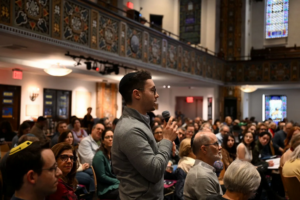
At Smol Emuni’s second annual US conference held at Bnei Jeshrun synagogue in Manhattan, March 2926
David Myers, a Jewish history professor at UCLA, said that for him, the organization has been a “lifesaver.” “It is a place where I can talk to the people I daven with and daven with the people to whom I talk,” he said, using the Yiddish term for praying.
Participants and speakers at the second annual conference included rabbis, Jewish educators, academics, activists and community leaders for a day of panels on Israel’s destruction of Gaza and allegations of genocide, immigration, empathy, activism, and more. However, the central issue was Israel’s push to annex the West Bank, the state’s complicity in settler violence and growing messianism in and outside the Israeli government, as well as what it all means for Jewish communities around the world and faith itself.
“A number of Jewish thinkers, from [Israeli intellectual Yeshayahu] Leibowitz to [American-Israeli rabbi David] Hartman, declared that the great moral test of our time was how the experiment of Jewish power and sovereignty in Israel would go. I think we must pose the question anew and be prepared to answer honestly: It is not going well,” said Myers. “In the wake of Gaza and the lethality imposed on Palestinians in the West Bank, we have to ask: Have we become akin to the eved ki yimloch, a servant who has come to rule, forgetting the experience of oppression to which our forebears were subjected?”
Kariv deemed the escalating settler violence in the West Bank as part of the government’s extreme policies. “This violence does not stand alone. It is part of a well-planned effort to bring about annexation in the West Bank, is fully supported and organized by the government,” said Kariv. “Jewish supremacy and violence are illegal, immoral and must be driven out of Israeli society.”
Rabbi Chaim Seidler-Feller, the former director of UCLA’s Hillel, went further, asserting that “a sickness has overtaken the religious Zionist community, through its engagement in and celebration of violence and might.”
Social media posts from an Israeli activist group describing West Bank settler violence continuing to escalate, despite the Iran war.
Seidler-Feller, a faculty member at the Shalom Hartman Institute, added that the mainstream religious Zionist community has “replaced God as a central belief with a central belief in Israel. Israel has replaced God.”
Gregory Khalil, the president and co-founder of the Telos Group, a Washington-based peacemaking nonprofit that specializes in engaging with communities of faith, said that part of the difficulty in cutting through the discourse is because Zionism isn’t a typical political ideology. “Being a Zionist isn’t like being a member of the Democratic Party. It’s an article of faith, beyond critique. There is ritual, identity and community. It has all the features of religion.”
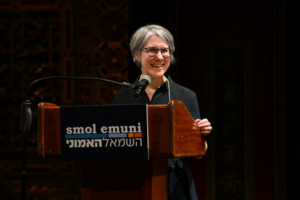
Smol Emuni US co-founder Esther Sperber at its second conference in March 2026
Khalil, a Palestinian-American who advised Palestinian leaders, including during the 2005 withdrawal from Gaza, received a standing ovation when he told the audience the writing of the threat of the October 7 attacks had been on the wall 20 years ago. “It was predictable and preventable. The disengagement was a shell game. It was designed to prevent the possibility of any Palestinian state. That was stated explicitly by Israeli politicians. Empowering Hamas was a strategic imperative of the Israeli government.” “This is the strategy we see unfolding today, and it is setting the stage for the West Bank, for Jerusalem, for the Third Temple movement and all these apocalyptic ambitions,” he added.
Minor drama occurred when Rabbi Saul Berman, a professor at Yeshiva University and Columbia University’s law school who was invited to share biblical perspectives on immigration in light of the Trump’s administration’s skyrocketing deportations, responded to a prior panel saying there’s a “theological conviction within Islam that is fundamentally at the root of the Islamic world’s inability to recognize Israel’s right to exist as a Jewish state.” Berman, who was arrested in 1965 for participating in multiple civil rights marches in Selma, Alabama, with Martin Luther King Jr., went on to say there are “whole generations of Muslim children learning to hate Israel.”
Organizers diffused the situation: “We invited you to speak about immigration and you expressed other views. As organizers of Smol Emuni, we respectfully disagree.” One attendee joked, “there’s always that uncle.”
A growing movement
Since the conference last year, Smol Emuni has grown, Sperber said. It hosted over 30 events, with more than 1,500 people participating in person. It has more than 5,000 people on its mailing list and engages with Jews around the world through its social media presence.
“We have new chapters starting around the country: in Los Angeles, Philadelphia, Chicago, New Jersey and Brooklyn. Chapters are starting soon in Boston and Washington, D.C. I even received messages from people in Australia wanting to start their own chapter,” said Sperber.
The U.S. group frequently works with the Israeli branch, although Sperber clarifies that they’re “not actually under one board and yet we’re in serious conversation, collaboration and affiliation.”
“The flavors of the conversation, even the language, might be a little different, and I think that’s a challenging thing: How do we hold onto the dialogue while also allowing each of us a little freedom? I think that’s the interesting piece – how we talk in slightly different dialects and still be part of the same movement.”
Rabbi Mikhael Manekin, a co-founder of the Israeli group, addressed attendees via a video call from Jerusalem. He spoke about the organization’s work on the ground, including its protective presence efforts in the West Bank through Bnei Avraham, in which Israelis and foreigners are placed in vulnerable Palestinian villages to deter settler and military violence.
“At the opening of Masechet Shabbat, the Sages teach that when a person performs a mitzvah properly, even for a brief moment, they can have a small glimpse of the world to come,” Manekin said, citing a tractate of the Talmud. “Maybe that is our work right now. Not to control history, or to have confident answers about how things can be solved, but rather to build moments and movements in which the world can briefly resemble the one we believe it can become.”
New voices of the Jewish religious left, like Meyer Labin – a Haredi creative director, columnist and Yiddish writer – and Musya Herzog, Smol Emuni’s social media director who grew up in the Chabad community of Crown Heights, spoke about the intersection of nationalism in the Haredi world. Aharon Dardik, a graduate student at Columbia University, spoke about his journey from being raised in an Israeli West Bank settlement to becoming a peace activist and refusing to serve in the IDF.
Rabbi Sharon Brous, who leads the IKAR community in Los Angeles, said she came back from speaking at the funeral of Jesse Jackson. “He called himself part of the disobedient left.” That, for her, is what Smol Emuni stands for as well. “We must not abide by the script that is built on fear, that prevents us from speaking the truth. The perpetrators aren’t going to stop because of me, but we collectively change the discourse in the diaspora and in the land, and that will have an impact,” said Brous. “Even though we’re not talking to the perpetrators of the violence, we are talking as a community saying we will no longer stand for this,” she added.
Sperber understands being left-wing as part of her obligations as a religious Jew. “Part of the Orthodox or religious idea is that there are commandments, and there are so many places where we are commanded to look out for the vulnerable, for those who are not part of our own community,” said Sperber. “One of the things that really pains me is that the people speaking in this messianic, supremacist religious voice are claiming that theirs is the more authentic Judaism.”
“But 2,000 years of Judaism that was respectful of neighbors, that valued diplomacy, that believed in looking out for the vulnerable – that’s not just a blip in history. We need to change that framing.”
This article is reproduced in its entirety