

Smashing a Palestinian monument, Israeli far-right lawmaker brought West Bank reality to light
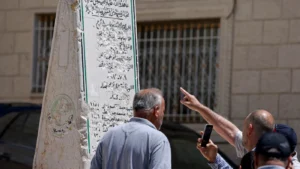
People inspect the damaged Palestinian memorial at the Madama village in the northern West Bank on 25 August 2026
Jack Khoury writes in Haaretz on 26 August 2026:
Far-right lawmaker Tzvi Succot’s destruction of a monument in a Palestinian village wasn’t anything out of the ordinary by the standards of daily life in the West Bank.
The only thing that was unusual in the attack on the Palestinian monument in the West Bank village of Madamah, near Nablus, was the fact that Succot is a Knesset member, who operated under the protection of the Israeli military, and whose actions were therefore widely covered internationally, turning what seems like a routine act into a major public issue.
For that, at least, we should thank him. Without even trying and against their will, Succot exposed the Israeli public to the reality that has been unfolding across the West Bank since the current government took office and even more intensely in recent months.
Anyone following what’s happening in the West Bank understands that this is not an isolated incident, but part of a dangerous and continuous escalation. Vandalism of Palestinian property, arson, attacks on families and settlers’ efforts to erase any reference to the Palestinian narrative have all become routine.
Much of this happens in the presence of IDF forces. The deliberate destruction of monuments by the army itself has also become increasingly common, particularly in West Bank refugee camps over the past two years.
For many Palestinians, the distinction between a soldier and a settler has become increasingly blurred. When they are attacked, it can be difficult to know who is standing before them: the person who is supposed to protect them as the representative of the occupying power, or the civilian who has come to attack them.
This event also exposed the hypocrisy of the Israeli media. These incidents happen again and again, but unless one becomes a spectacle capable of generating headlines, ratings and attention, they rarely seep into the Israeli public consciousness.
What Succot did on Wednesday was demonstrate just how invisible this reality is, unless it’s carried out by a public figure and unfolds live on camera.
Succot also exposed the contradiction at the heart of the army’s conduct. For years, the IDF has presented itself as a force responsible for maintaining order, combating violence and protecting the Palestinian population.
On the ground, however, the reality surrounding settler violence is often very different. The army is present, it can see what is happening, it sometimes fails to prevent the violence, and it often effectively clears the area for the violent instigators themselves.
Therefore, it was almost ironic to read Prime Minister Benjamin Netanyahu’s statement, in which he reminds everyone that the West Bank is under military rule, and that the Israeli army is the sovereign authority there. That is true. The army is the sovereign. However, it is a sovereign authority that often treats settlers with kid gloves, while Palestinians experience it as a boot that tramples their dignity day after day.
The Palestinian response is also telling. Palestinian President Mahmoud Abbas’ office called for a UN Security Council meeting, and demanded an end to attacks on civilians and property, including UNRWA facilities, which were raided in Qalandiyah on Tuesday. Even Hamas confined itself to condemnations and called upon the international community to intervene.
Notably absent from these responses were the familiar calls for a “day of rage,” a popular uprising or even a general strike. Is this evidence of successful Israeli deterrence? A deep fear of what may come next? Or an admission by the Palestinian factions that their public is already fed up with its leadership and unwilling to heed its calls? Most likely, it is some combination of all three.
Meanwhile, the rest of the world watches from afar. The United States is preoccupied with other fronts, from Iran and the Strait of Hormuz to the broader economic confrontation with Tehran and its potential repercussions for China. The situation in Palestinian territories, particularly the West Bank, has been pushed aside. Europe occasionally issues condemnations and the Americans sometimes offer lukewarm responses as well, but there is little meaningful pressure. And the Israeli public? For the most part, it simply moves on.
From Succot’s perspective, he got what he wanted: the spotlight. He also surely understands that such exposure could eventually translate into Knesset seats for a party struggling to pass the electoral threshold. So perhaps, instead of simply condemning Tzvi Succot, we should also thank him.
Not for destroying the monument, but for exposing what has been happening in the West Bank for years, largely under the radar: the violence, the helplessness, the starkly different treatment of settlers and Palestinians, the apartheid and the reality of annexation becoming entrenched on the ground. In short, the occupation.
Thank you, Tzvi Succot. At least this time, you brought the West Bank directly before the eyes of the Israeli public.
This article is reproduced in its entirety