

At 13, she became a third wife: Palestinian girls trafficked from the West Bank are trapped twice
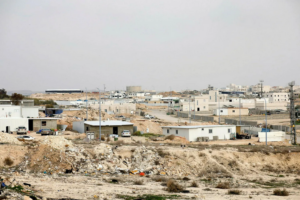
Hura, a Bedouin town in the south where a 40-year-old man ‘bought’ a 13-year-old girl
Eden Solomon reports in Haaretz on 14 April 2026:
Nothing about Intissar catches your eye. She wears just a little makeup, her veil is arranged nicely and her jewelry is unobtrusive. Her speech is ordinary, too, maybe too ordinary.
She relates her life story in a monotone, as if she were talking about someone she knew only casually. Not a single tear flows. The pain and sadness come across in her words, not her tone. Calmly, Intissar (not her real name) describes how her father sold her to a man for 1,000 shekels ($330); she was then beaten and raped. The daughters she would have also became the targets of the man’s angry outbursts, and her relatives turned their backs on her. For years she felt trapped.
That’s how it is when a woman without Israeli citizenship is forced into a marriage with a man she doesn’t know. But the feeling of being all alone isn’t unique to Intissar, 33. Both victims and experts told Haaretz how this widespread problem has been largely ignored.
Thousands of women are believed to have been brought to Israel from the West Bank, Gaza Strip and Jordan to be the second wife in a polygamous marriage. Most are from poor families and are often brought in by force. When they reach Israel, they discover that without citizenship, and often without any legal status, they’re almost completely dependent on their husbands. This creates fertile ground for control, exploitation and helplessness.
There are cases where women are sold or moved between family members like property while suffering constant sexual assault. Many times, when the marriage isn’t framed as a business deal, it has the characteristics of human trafficking, with the woman also facing the constant threat of deportation or separation from her children.
In some cases, the woman masquerades as a caregiver for an older man, or as the manager of the first wife’s household. But the husband isn’t always eager to help the victim gain legal status, leaving her with a difficult dilemma. The first option is to remain with her husband on his terms, without being able to open a bank account, access public health care or seek legal assistance. The second is to notify the authorities and risk deportation and separation from her children, probably forever.
Intissar is one of a minority who chose the second option, but only after years of abuse, only some of which she could have imagined.
She grew up in a West Bank village in a home where fear was the norm. She says her father was an alcoholic who regularly beat his family. Their finances were so desperate that her disabled sister was forced to beg. Intissar tried to build a different future; she finished high school, worked and started studying accounting.
But before she turned 18, her dreams were shattered. Her father married her off to another West Bank resident. Their marriage lasted about six months until her husband’s violence led to their divorce.
In the following months, Intissar studied, worked and was earning a decent salary, before the nightmare happened again. A relative from East Jerusalem more than 20 years her senior, a man already married and a father – with some of the children older than Intissar – suggested that she become his second wife. She refused, and that cost her.
The refusal “didn’t interest my father – he said, ‘I decide,'” Intissar recounts, adding that “he beat me a lot.” In the end, he simply sold her. Later on, her husband used this against her; “whenever we argued, he would remind me, ‘I bought you from your father.'” From the start, her place in the relationship was clear. Her husband even told her that he married her to fulfill his sexual fantasies. Her room was in the home of his first wife, a clear message about her status.
“His family called me a whore,” she says. “Later, we moved to a house next door to his mother and sister. I didn’t work, I had no social life, I was a punching bag. Since I had no legal status, he could control me.”
Intissar says the physical, sexual, verbal and emotional violence began on the first day of the marriage. That didn’t change after she became a mother, eventually of three daughters. He harmed them, too. When Intissar complained that her husband’s grandchildren were harassing her daughters, she paid a price. “It was a week of hell,” she says. “Beatings almost every day. He broke my ribs.” The rapes continued.
She wanted to complain to the police and end the marriage, but her family pressured her “to divorce quietly.” When she fled to her parents’ home in the West Bank for a month, her husband sent people to bring her back. She refused, but her children remained with him in East Jerusalem. They suffered, too, she says, noting that her eldest daughter tried twice to end her own life.
“My family told me I had nowhere to go with my children, and he wouldn’t let me take them,” Intissar recalls. One day in 2024, one of her daughters appeared in school with bruises on her body. A guidance counselor spoke with her, a police complaint was filed, the father was arrested and an investigation was launched that ended in a plea-deal conviction for rape of the girls’ mother and violence toward the daughters.
According to the Central Bureau of Statistics, in 2023 at least 2,400 Muslim men in the south had fathered children with more than one woman, at least one of whom was not an Israeli citizen.
With her husband behind bars, Intissar could reunite with her three daughters and enter a shelter in Israel. She eventually rented an apartment and today earns a living as a cleaner. She still fears saying where she lives – as her husband awaits his sentence, she’s still being persecuted by both his and her families.
At least for now she’s shielded from deportation by a court order she received with the help of the HaMoked Center for the Defense of the Individual. But she doesn’t have a permanent residence permit – a request on humanitarian grounds was rejected by the interior minister in 2024.
Fearing that she’ll be murdered if she returns to the West Bank, she dreams of normalizing her status in Israel so she can live safely. Her daughters are even daring to fantasize about a future here. One dreams of becoming a lawyer, another even wants to be in the police.
Bottom of the ladder
Exact data on the size of the phenomenon is hard to find, or on the extent of polygamy in Israel. But according to the Central Bureau of Statistics, in 2023 at least 2,400 Muslim men in the south had fathered children with more than one woman, at least one of whom was not an Israeli citizen.
Assuming that not all cases of marriage to more than one woman were officially reported or produced children, the number is likely much higher. Either way, these marriages with Arab Israeli men began after the June 1967 war when Jordan and Egypt lost the Palestinian territories to Israel. The whole land was open.
Rawia Aburabia, a senior lecturer at Sapir Academic College’s law school, said the original goal was reunification of families that had been separated after the 1948 war, or to facilitate true romantic relationships. But eventually the practice was used for polygamous marriages and control over women. The Islamic custom for the groom to pay the bride’s parents – money intended for the bride – has become another symbol of ownership in polygamous relationships.
“There are plenty of cases where the father of the bride takes the money,” Aburabia says. “So, marriages often whitewash the trafficking of women. This is especially the case with minors or women with no status who are brought in as second wives.”
She adds: “The Palestinian woman is at the bottom of the ladder – she has no status, is dependent completely on the mercy of men and has no family here or sources of support. It’s a lot harder to resist this phenomenon if you’re not a citizen.”
Aburabia focuses on cross-border marriages between Bedouin Israelis and women from the Palestinian territories. She notes the vulnerability in all directions, including the option of divorce. Under sharia law, children usually remain with the father, which often deters women from seeking a divorce.
Several women who spoke to Haaretz call this an ever-present threat when they get married, and women from the West Bank are especially vulnerable. “Men feel threatened by the fact that Israeli women are more aware of their rights,” a Bedouin activist says.
“In a place where women file complaints about violence and go to the authorities, they threaten the patriarchal order. Marriage to a West Bank woman ensures almost complete control because she’s entirely dependent on [her husband] economically and socially.” For men who want this kind of control, this is an incentive.
Houda (not her real name), a social worker in a Bedouin area in the south, knows about 130 women in a polygamous relationship and without legal status. But her tools for helping are scant. “According to the procedures of the Social Affairs Ministry, I’m prohibited from giving any help to an illegal resident unless the ministry has given that person an ID number,” she says. To apply for a number, several criteria have to be met. A woman has to have fled the West Bank due to a proven risk to her life, or due to persecution over gender identity. “None of these women meet these criteria,” Houda says.
The Social Affairs Ministry said that Israel provides social services to residents who meet various criteria “based on the law and according to social-work regulations. As an exception, the ministry has provided services to protect women from tangible danger, even when they are not residents, based on each individual case.”
The Justice Ministry said that it aimed to help root out polygamy, and that when “there is a suspicion of human trafficking, a victim is recognized as such by the ministry’s coordinator against trafficking, in consultation with a committee consisting of government officials, nongovernmental organizations and survivors of trafficking.”
A sales contract
October 7 brought change to this issue as well. Since Israel closed all crossings into the West Bank almost hermetically, fewer women have been entering polygamous relationships, even though that wasn’t the authorities’ intent. But the phenomenon hasn’t disappeared. “I continue hearing about this,” Aburabia says. “But I don’t know if they always come to Israel.”
She refers to another phenomenon: Men from Israel marrying a second woman from the West Bank, with the woman remaining there and the man occasionally visiting. “But there are cases of some of them coming here,” Aburabia adds.
One of these cases made headlines last year after it reached the courts, an exception. According to prosecutors, a woman from Hebron in the West Bank sold her 13-year-old daughter as a third wife to a 40-year-old man from the Bedouin town of Hura in the south. In that case, a contract stipulated the price of the child at 38,000 shekels, with the man paying the mother 1,500 shekels a month. No sexual relations would take place until the girl turned 16, the contract added. The Be’er Sheva District Court sentenced the man to 27 months in prison. The mother was convicted of offenses including human trafficking, but her sentence remains classified as part of a gag order. The child was placed under social services’ protection.
More common is the case of Doa (not her real name), a 37-year-old with children who lives in an unrecognized Bedouin village in the south. For a decade she has been “living in a prison within society,” she says. When she was 25, she was married off to a Bedouin Israeli 20 years her senior. This was in 2014, when her family in Jenin in the West Bank was in dire financial straits.
“I didn’t want to get married,” she says. “I dreamed of continuing to study, but the financial situation and the pressure from the people around me decided the issue. It wasn’t only the parents – society pushed it.” It turned out that her new husband was living in an unrecognized village, that he was married with children, and that she would remain without legal status or rights. “He told me that they were divorced, but when I came to Israel, I saw that his wife was still in the house,” Doa says.
Conditions in the Negev region in the south were also a nasty surprise. When talking about her former life, her eyes shine. She studied at a girls’ school and finished high school with distinction, studying for three years to be a medical secretary. She then worked as a typist at a sharia court and dreamed of studying for a master’s degree. “Life was okay,” she says. “With us, a woman studies first and then gets married.”
Then everything changed. She has been living without legal status for a decade with no basic rights, while contending with economic hardship and ongoing violence. She still thinks about returning to Jenin, but the four children all are Israeli citizens.
“If I divorce, they’ll be taken from me. According to sharia law, the children belong to the father. There’s no law to protect me,” she says, adding that she feels like a stranger in the village. “They tell my boy that he’s the son of the woman from Jenin. They keep reminding me that I’m not from here.”
Even if she doesn’t leave voluntarily, at any moment she could be deported. She doesn’t have a residence permit and her husband has never helped her attain legal status in Israel. A lawyer told her that her only chance was to try for family unification on humanitarian grounds. But ever since Moshe Arbel resigned as interior minister, with no one appointed to replace him, the committee handling these issues has been all but dormant.
Meanwhile, she lives in a small shack unfit for habitation, near the house of the first wife. Her husband seldom visits her. To earn a living, she looks after her neighbors’ children, making 1,400 shekels a month. She receives another 800 shekels in child benefits, a sum also controlled by her husband. “There’s hardly any food in the house. He sometimes brings some fruit,” she says.
Last September, her husband violently attacked her – in front of the children – after she used his credit card for food shopping. In photos she sent, her head is bleeding in a few places. She contacted the police and the husband was arrested and later ordered to stay away from her, but only for a limited time.
For their part, the police said they work systematically in their attempts to root out polygamy. “The polygamy unit in the Southern District, established at the end of 2024, coordinates this issue, acting to bring these cases to court,” they said.
“As part of this activity, complex investigations have been carried out, suspects have been arrested and charges have been filed for polygamy and associated violations. … When information or complaints are received raising suspicions of violence, exploitation or harm to women or minors, immediate action is taken to protect victims, with the required sensitivity.”
Doa, meanwhile, is resigned to her fate. But she still has one goal. “I dream of returning to the university,” she whispers, in tears.
This article is reproduced in its entirety