

Arab Israelis are being deprived of their collective Palestinian identity
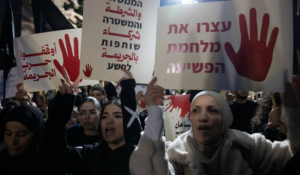
Protesters in Tel Aviv in January 2026 urging the government and police to do more to fight crime in the Arab community
Hadeel Azzam Jalajel writes in Haaretz on 15 May 2026:
Last week’s debate in the Knesset National Security Committee on a demand by Limor Son Har-Melech and Amit Halevi to outlaw the Arab community’s Higher Arab Monitoring Committee and investigate the organization’s leadership over support for terror didn’t happen in a vacuum. It was made possible because in recent years – especially since October 2023 – the infringement of human rights has accelerated when it comes to the status and political representation of the Palestinian citizens of Israel.
Arrests over social media posts, the hounding of university students and protesters, attempts to silence Palestinian political voices, bans on demonstrations and memorial events, and police violence don’t shock or trigger opposition among most Israelis.
The silence, the apathy and sometimes the cooperation of many politicians and regular Israelis laid the ground for a Knesset debate on breaking up the leadership of one-fifth of Israel’s citizens.
This isn’t just another step against the Palestinians in Israel. It’s part of an expanding and intensifying trend constraining their political and civic space. It encompasses a range of events that reflect the depth of the erosion of democratic values. It’s also evidence of the growing legitimization of violations of Arab citizens’ fundamental rights, with their citizenship emptied of content.
To understand the severity of the situation, you have to understand what exactly would be banned. A clear political outlook underpins the security-related rhetoric and allegations of “support for terror”: Arabs may be allowed to work or study or thrive as individuals, but organizing around a common identity, an independent leadership and a collective political consciousness challenges the constellation of power, undermining the vision of Jewish supremacy that guides many Israeli politicians.
It’s a reminder of a simple fact that many prefer to suppress: A Palestinian community in Israel has rights, memory and a future and won’t accept the erasure of its national identity and the infringement of its political rights.
It’s therefore important to understand why the monitoring committee’s existence irks the right wing and what’s really behind the attempt to criminalize it. The committee is the Arab-Palestinian community’s broadest representative body in Israel. It brings together Arab mayors, lawmakers, political parties, committees and civil society groups, and for decades has served as a key political and public framework for the community.
It has been at the forefront of battles against the expropriation of land, the demolition of homes, the occupation, the wars, the discrimination, the establishment-based racism, and the neglect of Arab communities and citizens and the fight against organized crime. Earlier this year, the committee organized a large demonstration in Tel Aviv attended by tens of thousands of people – both Palestinian and Jewish.
For many Jewish Israelis, the monitoring committee is a foreign entity that has no presence in their consciousness, but for Palestinian citizens of Israel, its very existence has a deep significance. In a community that has been subjected to structural discrimination for decades – including land expropriation, constant efforts to break apart any independent political leadership and perpetual suspicion of any expression of Palestinian identity – the committee is one of the only spheres for expressing an independent collective voice.
The committee expresses the basic right of a national minority to organize, develop joint political positions, protest and fight for its existence and future. The importance of a collective framework becomes that much greater when the state is adamant about treating us as isolated individuals. Simply put, the monitoring committee expresses a refusal to be erased.
The aim to erase us has found expression in repeated attempts to disqualify Arab parties and candidates from Knesset elections, the passage of the nation-state law institutionalizing a civic and national hierarchy, the persecution of rights groups, the silencing of Arab political activity and the labeling of any expression of Palestinian identity or solidarity as a security threat. Since October 2023, this process has greatly intensified. University students have been suspended, employees have been fired, citizens have been arrested over social media posts and an atmosphere of fear and silencing has spread everywhere.
The timing of the debate over the monitoring committee is no coincidence. The next general election is in the air and incitement against Arab citizens and their leadership has again become an effective and convenient political tool. Instead of finding solutions to the deep crises facing the country – from the war to the plague of violence and murder and the threatened economy – it’s much easier to unify people around an “enemy within.” Politicians have again been scoring points through delegitimization, fear and incitement. As usual, the Arab community has been paying the price.
This pattern is very familiar both in Israel and around the world. Nationalist and populist regimes often begin by labeling minorities and opposition groups “enemies within” and then expand the criminalization of protest and political organizing, gradually eroding democracy as a whole.
The tools developed against one deprived group almost never stop there. A society that agrees to depict the leadership of one-fifth of its citizens as a “security threat” solely due to its political positions – which can be criticized and debated – is a society gradually erasing a democracy that the society itself has been fighting for. After all, in a democracy, political participation isn’t supposed to be conditioned on an ideological loyalty test.
We must not be silent in the face of these developments. Silence among Israelis who consider themselves “democratic” isn’t a neutral act. It allows dangerous norms to become routine.
Anyone who believes in political freedom, civic equality and genuine democracy must understand that the fight against the persecution of the monitoring committee isn’t the Palestinians’ battle alone. It’s a fight over the boundaries of the democratic space as a whole, and people who remain silent today amid the persecution of Palestinians in Israel may discover tomorrow that there is no democracy left for them to defend – or to defend them.
Hadeel Azzam Jalajel is codirector of public affairs at the Jewish and Arab nonprofit group Sikkuy-Aufoq.
This article is reproduced in its entirety