

Amid genocide in Gaza, why must Palestinian journalists uphold the illusion of neutrality?
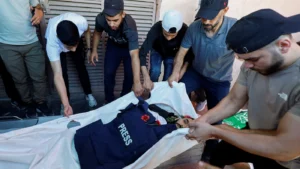
Mourners gather around the body of Al Jazeera Mubasher cameraman Ahmed Wishah, his press vest laid on the shroud, at Al-Aqsa Martyrs Hospital in Deir al-Balah, central Gaza, on 21 June 2026
Ahmed Abu Artema writes in Middle East Eye on 20 August 2026:
On 20 June 2026, the Israeli army killed Al Jazeera Mubasher cameraman Ahmed Wishah in a drone strike, less than two and a half months after the killing of his brother, Al Jazeera Mubasher correspondent Mohammed Wishah, who was targeted by the same army on 8 April.
After Mohammed’s death, Ahmed appeared on Al Jazeera pleading: “Let Mohammed be the last journalist Israel kills. We don’t want any more journalists targeted. My message to the world is to stop the occupation from killing journalists.”
His global call went unanswered, and shortly afterwards, Ahmed was killed by the Israeli army.
In a study published on 1 April 2025, Brown University’s Costs of War Project concluded that the war on Gaza had killed more journalists since October 2023 than the US Civil War, the First and Second World Wars, the Korean War, the Vietnam War – including the conflicts in Cambodia and Laos – the Yugoslav wars of the 1990s and 2000s, and the post-9/11 war in Afghanistan combined.
Moreover, in its annual round-up published in December 2025, Reporters Without Borders (RSF) found Israel responsible for nearly half of all journalist killings recorded worldwide that year, making occupied Palestine the most dangerous place in the world for journalists.
New MEE newsletter: Jerusalem Dispatch
Sign up to get the latest insights and analysis on Israel-Palestine, alongside Turkey Unpacked and other MEE newsletters
By the previous August, the organisation had already documented some 220 journalists killed by Israeli forces in the Gaza Strip in less than 23 months. That figure had risen to 259 by March 2026.
Why does Israel kill Palestinian journalists? Just as it kills children and other civilians, bombs hospitals and destroys infrastructure, it feels no obligation to offer convincing justifications, because it believes that it is immune from accountability.
The journalists’ tent
In November 2023, I was discharged from Nasser Hospital in southern Gaza after receiving treatment for injuries sustained in an Israeli air strike that targeted my home and killed seven members of my family, including my son Abdullah.
I had to leave my hospital bed to make room for another wounded person, given the influx of thousands of casualties.
I had nowhere else to go. Our house was destroyed, my family was displaced, and I still needed time to recover.
A group of journalists welcomed me. They had set up a tent in the hospital courtyard for their work, and they offered to host me there.
They took me in, shared their food with me and gave me a place to sleep. I stayed with them for a month, until we were forced to evacuate when the Israeli military invaded Khan Younis and its tanks advanced towards the hospital.