

After Ireland partially bans trade with Israeli settlements, the UK must go further
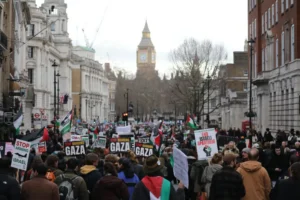
Protesters throng Whitehall, London, during a national demonstration for Palestine on 31 January 2026
Hannah Bond and Karol Balfe write in Middle East Eye on 16 July 2026:
“We live each day fearing that we may be shot or killed, and in constant fear of being attacked and beaten.” These are the stark words of Najwa, a Palestinian farmer in Hebron in the occupied West Bank, whose land, family and community are under daily attack.
Israeli settlers have stolen their livestock, trampled their crops, destroyed their greenhouses, broken into their home and attacked them with pepper spray. The relentless campaign of violence, harassment and intimidation has driven most of Najwa’s neighbours off their land; only a few families remain in the valley.
Today, settler violence in the occupied West Bank has soared to its highest level since UN monitoring began in 2006, with an average of six attacks recorded each day. Settlers have shot and stabbed children, committed sexual violence, and set fire to mosques – yet they benefit from near-total impunity. Palestinian women and girls are at particular risk: not only do they face violence and harassment from settlers, but they are also often forced to stay at home for protection, cutting them off from education and reproductive healthcare.
These horrific acts are not isolated events, and the people responsible for them are not rogue actors. They are at the vanguard of a settlement expansion project that is directed, funded and authorised by the Israeli state itself, and made possible by its discriminatory policies and practices. It’s a project that has the ultimate aim of territorial expansion, achieved through an appalling strategy of illegal land annexation and ethnic cleansing.
The UK government already accepts that Israeli settlements in the occupied West Bank are illegal under international law. So why does it continue to permit trade that helps normalise and sustain them?
Alarming growth
Israeli settlements already control more than 42 percent of West Bank territory, confiscated from Palestinian communities, along with the majority of the region’s water resources. These illegal settlements are supported by a massive system of bypass roads and railways, as well as industrial parks for settlement-based businesses.
And they are growing at an alarming pace. This year alone, Israeli authorities extended civil and administrative authority across the West Bank, approved 34 new illegal settlements, and allocated record funding for settlement infrastructure.
According to a 2024 advisory opinion from the International Court of Justice, states must take concrete steps to end any support that maintains Israel’s illegal occupation of the West Bank. This isn’t a suggestion; it’s an obligation.
The fact that trade is still allowed means that dates, grapefruits or avocados grown on land forcibly stolen from Palestinians can appear on supermarket shelves in the UK. A recent investigation by the legal non-profit Global Echo found that one in six Israeli shipments to the UK and EU contained agricultural products that originated in illegal settlements.
**** ****
The UK now faces a choice: continue enabling a system it recognises as unlawful, or join a growing number of countries prepared to match their words with action.