

Israel’s siege cripples transport system in Gaza, cuts off food and medicine, pushing residents back toward famine
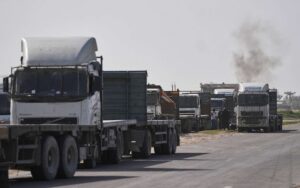
Palestinian commercial trucks are seen parked in an area in Deir al-Balah near the Kissufim crossing as they wait for permission to receive a cargo of goods for sale in the Gaza Strip, 27 January 2026
Euro-Med Human Rights Monitor reports on 9 August 2026:
Israel persists in maintaining its illegal siege on Gaza, intentionally disrupting transportation and freight by destroying trucks and warehouses of transport companies. It also targets and detains drivers and blocks the entry of trucks, spare parts, and essential materials. This obstructs the delivery of food, medicine, and aid through crossings to the people, risking a return to famine in the Gaza Strip.
Furthermore, Israel enforces a comprehensive policy that disrupts the entire supply chain, starting from the entry of goods and aid through crossings until they reach the population. Even when trucks are permitted to cross into Gaza, it is not guaranteed that their cargo will reach those in need, due to the destruction or impairment of the transportation, storage, and distribution infrastructure.
Nahed Shuhibar, head of Gaza’s Private Transport Association, told Euro-Med Human Rights Monitor that before the Israeli genocide, Gaza had about 1,200 trucks delivering food, medicine, fuel, animal feed, building materials, and other essentials. Since then, only around 400 trucks remain after Israeli bombings and destruction, with roughly 100 out of service due to restrictions on the entry of spare parts, tyres, oils, and batteries. As a result, just about 300 trucks, which are only 25 per cent of the original fleet, are currently operational.
The total Israeli ban on importing essential maintenance materials has threatened the operation of the remaining trucks. Workers had to dismantle broken-down trucks and reuse their parts to keep others operational. Additionally, the cost of changing a single truck’s oil skyrocketed from roughly 450 shekels (about $150) before the genocide to around 100,000 shekels (about $33,000) now, due to a severe shortage of supplies. The price for one kilogram of engine oil, if available, reached nearly $1,100.
This ban halts the main way of delivering food, medicine, and fuel to an enclave where Israel has mostly destroyed its infrastructure and local production, leaving residents almost entirely reliant on foreign aid.
Field data indicates that Israeli attacks have damaged or destroyed over 150 trucks during their operations, mainly on roads leading to or near the Kerem Shalom crossing. These attacks have resulted in the death of more than 20 drivers, including four since the ceasefire in October 2025, and have led to the arrest of 15 others, some of whom have been detained for two years.