

Ein al-Auja: How settler attacks and water diversion erased a Palestinian community
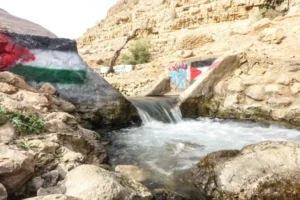
The spring that formerly fed al-Auja in the occupied West Bank
Majd Jawad reports in Middle East Eye on 13 August 2026:
Haitham Rashaidh was among the last to leave his home near Ein al-Auja, a natural spring and waterfall north of Jericho in the occupied West Bank.
His family packed up their tents and heaped all their belongings onto a tractor, and then began the two-hour journey across difficult terrain towards al-Balqa, a sparsely populated area of the Jordan Valley, where they set up camp alongside their displaced neighbours.
**** ****
The predicament facing his community has escalated sharply over the last couple of years, since the events of 7 October 2023 began redefining Palestinian life across the occupied territories. Before the Gaza war, forced displacement from the Ein al-Auja area had been minimal, with the United Nations Office for the Coordination of Humanitarian Affairs (Ocha) recording only two settler attacks resulting in casualties or property damage between 2017 and 2023.
But since early 2024, several new illegal Israeli settlement outposts have been established in the area – and the attacks have consequently ramped up, with at least 38 documented cases last year.
“Access to water has been especially compromised; settlers believed to be from these settlement outposts have repeatedly cut or damaged water pipes connected to [Ein al-Auja] spring, blocked access roads used for water collection and delivery, emptied households’ water tanks, and intimidated or assaulted residents and herders attempting to collect water, severely undermining livelihoods,” Ocha noted in a January report.
In one documented case earlier this year, 26 families, comprising 124 people, were forcibly displaced amid ongoing violence by armed settlers and Israeli troops.
“It felt like they were testing how long we could endure,” Rashaidh said. “In the end, it wasn’t one incident that forced us out, but the repetition of everything, over and over again – until staying became impossible.”
Sustained decline
The dramatic and sustained decline of Ein al-Auja spring in recent years mirrors the disappearance of the surrounding Palestinian community. Its water flow, historically estimated at more than 1,000 cubic metres per hour – and potentially double that in rainy seasons – has dropped by 50 to 70 percent in recent years, and sometimes runs entirely dry, according to Ayman Abu Zaher, an environmental researcher who monitors the local water system.