

They fought back against violent settlers. Now they’re branded as terrorists
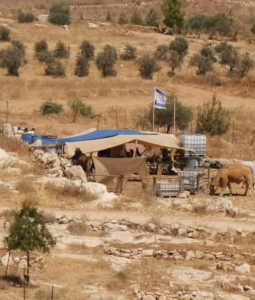
The outpost near Halat al-Hams, July 2026
Gideon Levy reports in Haaretz on 2 August 2026:
Moussa Adais, a 65-year-old farmer with a chronic illness and the father of 10, lay on the sofa in the living room of his home in the remote village of Halat al-Hams in the South Hebron Hills, between Yatta and Samu, on Monday afternoon. His face was gray and drawn.
His son Saddam inserted an IV. He studied medicine in Yemen and is now an anesthesiologist at the government hospital in Ramallah. Two of Moussa’s sons and his grandson are being held by the IDF and police on suspicion of snatching a weapon from a settler who entered their land with his herd on Saturday.
After months of complete helplessness in the face of settler violence, Palestinians appear to be slowly finding the courage to resist, or perhaps their despair has grown so deep that they have begun pushing back against encroaching settlers. Last Friday in the town of Tell, four Palestinians from one family and two Israelis were killed after settlers entered the town. In Halat al-Hams, residents also appear to have reached the point where they are no longer willing to bow their heads. Here, four members of a single family were arrested.
The road to Halat al-Hams is rough and rocky. The homes are already equipped with security cameras, and some of the fields are enclosed by fences. Since a new settler farm outpost was established on village land in the valley facing it about three months ago, life for the residents has changed beyond recognition.
They say they know what comes next. The settlers want to provoke confrontations and violent resistance, so they can brand the residents as terrorists and the village as a terror stronghold. From there, it’s a short path to expulsion and the demolition of their homes. And it works. This week, almost every Israeli media outlet described the events in Tell as an “attack” committed by “terrorists.” The Adais family of Halat al-Hams is now the next family of “terrorists,” and their village the next “terror nest.”
About 4.5 acres of cultivated land and a small flock of sheep and a herd of cattle provide the Adais family’s livelihood. They can no longer reach the fields. The livestock can no longer be taken out to graze because settlers have taken control of the valley across from the village, cutting the residents off from most of their land. They also can no longer reach the water wells they dug themselves.
The valley is entirely controlled by the residents of the outpost, whose so-called “farm” consists of little more than a spacious tent and a small wooden structure beside it. Brown cows lie near the tent, black goats sprawl around its perimeter, and, disgracefully, an Israeli flag flies overhead.
On Saturday morning, several armed settlers came through Halat al-Hams on ATVs for a “tour”, breaking through fences the villagers had erected around their fields for protection. A few hours later, around noon, one of Moussa’s sons, Assam, spotted a settler shepherd approaching the family’s land with a herd of goats.
Footage from a village security camera shows Assam approaching the settler empty-handed. A physical confrontation immediately broke out between the two. Assam tried to wrestle the settler’s rifle away, and the two struggled over it. Several members of Assam’s family joined the scuffle, which lasted several minutes. As far as is known, the rifle ended up on the ground. Assam, they say, never fired it.
“If my brother had wanted to shoot the settler, he could have,” Saddam said this week.
By then, six or seven armed settlers had arrived, along with soldiers from the nearby Susya base overlooking the valley. According to Saddam, both the soldiers and the settlers opened fire toward the village.
The soldiers searched homes and questioned residents. They arrested Assam’s brother Ibrahim and Assam’s son Moussa. They also questioned Saddam but did not arrest him. Accompanying the soldiers was a settler known to the residents of Halat al-Hams from the illegal outpost at ancient Susya, where the residents of the original Palestinian village of Susya were expelled decades ago. They now live just across the road, where they continue to face harassment by settlers.
Early Monday morning, the army returned, this time arresting Mohammed, Assam’s nephew. It was 4:30 A.M. when soldiers forced their way into the house, Mohammed recounted after being released shortly before our arrival.
He was first taken for questioning at the Etzion military base and later transferred to the Kiryat Arba police station. During the drive, he said, he was forced to lie face down in the jeep and was beaten. After questioning, he was driven to the Bani Naim junction, far from the place where he had been arrested, and released there.
The soldiers who raided the family’s home were looking for Assam. His father told them he was not home and promised to bring him wherever they instructed. According to his brother, Assam had gone into hiding after the incident out of fear of settlers. The family says that had the army asked for him on Saturday night, he would have surrendered then.
On Monday morning, Assam turned himself in to the Civil Administration in Hebron. Mohammed was released shortly afterward, though it is unclear whether the two events were connected.
The IDF Spokesperson told Haaretz: “Security forces arrested two terrorists who were involved in the attack and the snatching of a weapon from an IDF soldier who was on leave in the Susya area of the Judea Brigade. Subsequently, IDF forces carried out an operation in the area of Yatta in the Judea Brigade and arrested another terrorist who was involved in the weapon snatching. The following morning, another terrorist involved in the attack surrendered to the Civil Administration forces.”
Asked whether any settlers had also been arrested, the police spokesperson’s office said: “The investigation of the case was assigned to the Central Unit of the Judea and Samaria District. As part of the investigation, several suspects were arrested and testimony was collected. The investigation is still in its early stages, and naturally we cannot elaborate further. It is continuing with the aim of uncovering the truth and bringing those involved to justice.”
On Thursday, the settler organization Honenu reported that the settler whose weapon was allegedly snatched had himself been questioned under caution on suspicion of assault.
The harassment of Halat al-Hams residents did not begin last Saturday. There have been repeated attempts to steal livestock, agricultural equipment has been vandalized, and homes have been broken into. Residents also say one settler regularly bathes naked in one of the village wells in full view of women and children from the village.
Moussa Adais on the roof of his home in Halat al-Hams this week. The family can no longer reach its fields or take its livestock out to graze. Credit: Alex Levac
While we were in the village, residents reported that soldiers from the regional defense battalions, effectively the settlers’ army, had arrived at a local farm intending to confiscate an electric ATV belonging to one of the farmers. When its owner, Shadi al-Khatib, refused to hand over the keys, the soldiers handcuffed him, arrested him and took him to their base.
The IDF Spokesperson said this week that “the described incident is not known.”
Since the killings in Tell, fear has spread across the South Hebron Hills. Nasser Nawajah, head of the council of the neighboring village of Susya, who accompanied us, said residents have stopped sleeping.
“We are a small, weak and nonviolent village, and we’re afraid. Our homes are shacks. The settlers come to our village even though a military order bars them from entering. The soldiers come with them, and they don’t even enforce the order.
“Everything now is connected to Israel’s elections. The settlers are looking for friction with the residents. They’re looking for an excuse to crack down on us before the elections. They’re looking for opportunities to expel more people, especially from vulnerable villages like Susya and Halat al-Hams. They’ll call us terrorists and expel us.
“One of the settlers said they want to connect this area to the settlement of Otniel ‘because of the terror.’ That means erasing every Palestinian village in the South Hebron Hills. The government wants that too. Since it isn’t allowed to attack Iran, it wants to set the West Bank on fire before the elections.”
Tell remained under closure throughout the week, and the IDF demolished homes there as punishment, residents said. In Halat al-Hams, they waited for the sons who, as the family puts it, had gone out to defend their home. In the West Bank, what Jews are permitted to do is forbidden to Palestinians.
This article is reproduced in its entirety