

‘They want to make us leave’: Israel destroys West Bank wells serving Palestinian herders
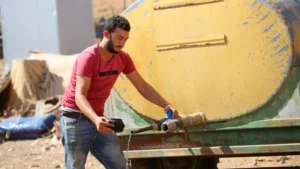
Water trucked in after wells in Ras al-Ahmar were destroyed by settlers, August 2026
Mojahid Nawahda and Teebah Assi report in Middle East Eye on 3 August 2026:
As first light reaches the scattered tents and animal pens of Ras al-Ahmar in the northern Jordan Valley, the silence is broken only by the cries of thirsty livestock waiting for water that no longer comes.
Days after Israeli forces destroyed three of the Palestinian community’s main water wells, residents are scrambling to secure enough water for their families, crops and animals in one of the occupied West Bank’s driest regions.
For 60-year-old Ali Bani Odeh, the destruction of the wells was more than merely the loss of infrastructure. A father of four and grandfather of 14, he has spent decades farming and raising livestock to support his family in Ras al-Ahmar. Now, like dozens of other families, he is uncertain how long they can continue living on the land without a reliable water supply.
“Water is everything for us,” Ali told Middle East Eye. “Without water, we cannot live. We need it for our families, our sheep and our crops. Since the wells were destroyed, we have been forced to bring water from town at a much higher cost, and even then, we’re not always allowed to pass.”
Families must now haul water from distant towns at far greater expense, while military checkpoints and movement restrictions frequently delay or prevent tankers from reaching the village.
According to Ras al-Ahmar village council head Abdullah Bisharat, the three destroyed wells supplied more than 47 Palestinian families, serving over 600 people and irrigating around 7,500 dunams of farmland.
The wells also sustained thousands of sheep and goats, the main source of income for many families. “The wells were the lifeline of this community,” Bisharat said. “Their destruction has affected every aspect of daily life, from drinking water and agriculture to livestock, leaving dozens of families struggling to meet their most basic needs.”
Settler attacks
Residents say the destruction marked the worst escalation in a months-long water crisis caused by Israeli settler attacks.
They say settlers repeatedly cut the pipelines supplying the community, forcing families to rely on costly water tankers. This time, however, the wells themselves were destroyed, eliminating the community’s main source of water.