

World Council of Churches: Israel must be held accountable for international law violations
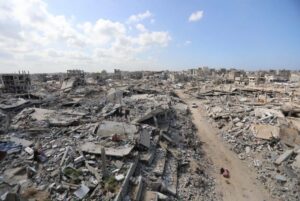
Scene showing the widespread destruction of buildings and infrastructure caused by Israeli attacks during the Gaza genocide in Beit Lahia, northern Gaza, 22 February 2026
Jeff Wright reports in Mondoweiss on 11 March 2026:
Last week, the World Council of Churches (WCC), headquartered in Geneva, launched a month-long campaign titled “From Condemnation to Consequences.” The program calls its member churches—clergy leaders and lay alike—to hold Israel accountable for its failure to fulfill its obligations under international law.
George Sahhar, Advocacy Officer in the Jerusalem Liaison Office of the World Council of Churches, tells Mondoweiss. “When attention is focused on the war in the Middle East, we want the world to see that human rights violations by Israel against Palestinians continue, and that annexation is ongoing and deepened.”
During a webinar introducing the March 4-31 campaign, Kenneth Mtata, WCC Program Director for Life, Justice and Peace, said, “[O]ur campaign needs to remain focused on the commitments that the churches have made together, with all their partners, to see how we move from the statements and condemnation of the occupation and annexation of Palestine, and to try to translate this into concrete changes and transformation.”
“When attention is focused on the war in the Middle East, we want the world to see that human rights violations by Israel against Palestinians continue, and that annexation is ongoing and deepened.”
In short, the World Council of Churches, comprised of 356 member churches representing more than half a billion Christians around the globe, has acknowledged that offering “thoughts and prayers” alone is not enough to address Israel’s decades-long occupation and its accelerated program of genocide and ethnic cleansing.
In an alert to be published by Kairos Palestine later this month, Dalia Qumsieh, human rights lawyer and Founder/Director of Balasan Initiative for Human Rights, insists, “Churches are called to realize their power and leverage in action, with a full understanding that statements don’t stop bulldozers, condemnations don’t restore stolen lands and resources, and prayers alone cannot restore families who were uprooted from their ancestral lands. Only solid action will.”
The WCC’s appeal to members in the pews—“reach out to your elected officials [and] your faith leaders to call for renewed efforts for a just and sustainable resolution of the Palestinian-Israeli conflict”—is an implied acknowledgement that with few exceptions heads of church around the globe have not yet responded to the pleas of Palestinian Christians to stand with them in solidarity, to act with courage and conviction in naming the realities that Palestinians are suffering: genocide, ethnic cleansing, and settler violence.