

Israel’s war on Gaza’s healthcare continues in full force under ‘ceasefire’
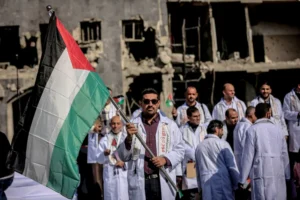
A view from the graduation ceremony held at Shifa Hospital in Gaza City for 170 doctors who earned their specialist certificates from the Ministry of Health, 25 December 2025
Mads Gilbert writes in Al Jazeera on 6 February 2026:
On November 5, 2023, just a couple of months after the beginning of this latest assault on Palestine, my dear friend and colleague, Dr Maisara Azmi Al Rayyes, aged 28, was brutally murdered along with most of his close family in an Israeli military missile strike on his family home in Gaza City. A brilliant and gifted young doctor specialising in women’s and children’s health, Dr Maisara had returned to serve his besieged and occupied homeland after completing his master’s degree at King’s College London as a Chevening Scholar in 2019. Until the day he was killed, he repeatedly risked his life to provide desperately needed healthcare to his people under relentless Israeli attacks.
Dr Maisara was just one of more than 1,700 Palestinian healthcare professionals killed in Gaza since October 7, 2023.
As I wrote this, I received news from Gaza that paramedic Hussein Hassan Al-Samiri, aged 48, from the Palestinian Red Crescent Society, had been killed in an Israeli air strike targeting clearly identified ambulance crews in the al-Mawasi area, west of Khan Younis. The strike hit the rescue team as they attempted to reach people wounded in an attack on tents sheltering displaced families – an attack that killed 21 people, including five children.
Al-Samiri was the fourth healthcare worker killed in Gaza since a so-called “ceasefire” was declared in October 2025 and the second in less than 24 hours. He was killed in a double-tap attack: an initial strike followed by a second, deliberate attack targeting medical responders and rescue teams as they rushed to treat the wounded. This war crime had been in the Israeli playbook for many decades. I personally witnessed double-tap attacks on ambulances and rescue teams in Beirut during the brutal and bloody Israeli invasion of Lebanon in 1982, and later in Gaza during innumerable Israeli attacks.
In the past two years, many Palestinian health workers were also executed by Israeli forces merely for doing their jobs.
Last March, for example, Israeli soldiers executed 15 Palestinian paramedics and civil defence rescuers one by one in the al-Hashaashin area as they rushed to help the wounded at the site of a missile attack, before burying their bodies in a shallow mass grave in an apparent attempt to conceal the crime. Video footage of the killings, recovered from the phone of one of the dead rescue workers, later circulated widely across international media.
The execution of medical responders in al-Hashaashin marked one of the most extreme manifestations of Israel’s targeting of healthcare workers.
The gruesome footage shocked many, but — like irrefutable evidence of double-tap strikes — it did not prove enough to move Western governments backing Israel into meaningful action. A few issued mournful statements, others delivered stern warnings, but none acted to stop or effectively sanction Israel.
Would these governments have remained silent if Palestinian resistance had targeted Israeli healthcare workers and ambulance crews in the same way? Would they have merely paid lip service to human rights or swiftly condemned, sanctioned and punished the perpetrators? We know the answer. The continuation of carnage in Gaza reflects profound racist structural violence sustained by Western indifference. This indifference grants the settler-colony’s genocidal government impunity, and poses a deadly threat not only to Palestinian lives, healthcare and human rights, but also to the credibility of what is described as the rules-based international order, to all of us.
The scale of destruction facing Gaza’s population is staggering. According to Gaza’s Ministry of Health, at least 71,000 Palestinians have been killed since October 7, with tens of thousands more still trapped beneath the rubble. Civilian death rates exceed 80 percent, with children, women and elderly people forming the overwhelming majority of victims. Life expectancy in Gaza has collapsed from approximately 74 years to around 35 years as a result of military violence, starvation, displacement, disease and the systematic destruction of medical infrastructure.
Today, Palestinian healthcare workers continue to operate under unimaginable conditions. Hospitals and clinics have been bombed, invaded or burned, yet their services continue, often at minimal capacity. The resilience and bravery of Gaza’s medical professionals is extraordinary, but cannot compensate for the systematic dismantling of the healthcare system.