

Why the death penalty would cement the Israeli radical right’s ascendancy
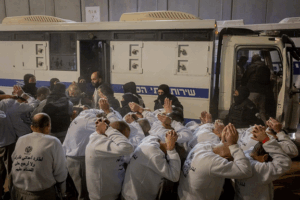
Israel Prison Service officers prepare Palestinian prisoners for release as part of a hostage deal between Israel and Hamas, at Ketziot Prison in southern Israel, 26 February 2025
Ron Dudai writes in +972 on 26 November 2025:
On 10 November, a bill enabling the death penalty for Palestinians cleared its first major legislative hurdle in the Israeli parliament. The single-page proposal, which now moves to committee before potentially returning to the Knesset for its two final votes, would mandate a death sentence for anyone convicted of “intentionally or out of indifference causing the death of an Israeli citizen, when the act is carried out from a racist motive or hate to a certain public … and with the purpose of harming the State of Israel and the rebirth of the Jewish people in its homeland.”
The bill is extreme even by current Israeli standards. It creates a new capital offense, makes the death penalty mandatory under vaguely defined conditions, and eliminates judicial discretion altogether. Crucially, its language is explicitly discriminatory, applying to Palestinians who kill Jews but not to Jews who kill Palestinians. As one of the bill’s sponsors, MK Limor Son Har-Melech, put it bluntly, “There is no such thing as a Jewish terrorist.”
A second section addresses Israel’s military courts, which technically already have the authority to impose capital punishment on Palestinians but have never done so due to longstanding government policy. Here, the bill seeks to dismantle the primary safeguards that have limited this power: the requirement that a three-judge panel reach a unanimous verdict, and the army Chief of Staff’s authority to commute death sentences. These protections have historically ensured that valid death sentences remained exceedingly rare and, when issued, swiftly commuted. Removing them in a system widely criticized for failing to ensure fair trials would carry unprecedented risks.
Although the vote on the death penalty bill received coverage in both local and international media, it prompted little sustained outcry, despite its clear violation of international laws protecting the right to life. With at least 70,000 Palestinians and 2,000 Israelis killed over the past two years or so, the issue may seem almost trivial by comparison. Yet much is at stake — for Palestinians, for Israeli society, and for global efforts to abolish capital punishment.