

Why Israel’s police force is troubled by Ben-Gvir’s shadow militia
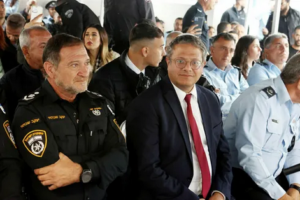
National Security Minister Ben-Gvir (R) next to police chief Kobi Shabtai, March 2023
Josh Breiner reports in Haaretz on 29 March 2023:
Senior members of Israel’s police, including Commissioner Kobi Shabtai, strongly oppose the formation of a new national guard that will be subordinate to National Security Minister Itamar Ben-Gvir.
While Ben-Gvir has not yet presented any details or a plan for it, he has already raised the needed budget of about 300 million shekel ($85 million) over the next two years.
The spokesmen for both the National Security Ministry the Israel Police released a statement following inquiries by reporters saying that Ben-Gvir and Shabtai met on Tuesday. During the meeting, both agreed that the police will present Ben-Gvir with an outline for the establishment of the national guard following the commissioner’s earlier request.
The establishment of a national guard resurfaced Monday as the outcome of an agreement between Ben-Gvir and Prime Minister Benjamin Netanyahu that enabled the delay of the judicial overhaul. This came after the ultra-nationalist minister had threatened to resign over Netanyahu’s announcement that he would shelve the legislation.
In the coalition deal between the Likud and the far-right Oztma Yehudit party led by Ben-Gvir, there is a clause mentioning the establishment of a national guard as part of Israel’s Border Police. It also mentions the fact that such an organization would report directly to the National Security Ministry.
“It could be very dangerous,” says a senior police official, “think about yesterday the minister would have sent companies from the National Guard to deal with the protesters, it looks bad.” The official added that “He has tried to subject the Commissioner to himself and failed, and now he’s trying to have his own police.”
“No one knows exactly what he [Ben-Gvir] wants; what the structure of this organization is; what the ranks are; how it’ll be formed and what the different divisions are. It’s all just talk,” one senior defense official said to Haaretz.
Haaretz has also learned that police chief Kobi Shabtai had said in closed meetings that “the country must not have two police forces. There’s only one commissioner.” Shabtai insists that any new law enforcement body will be subordinate only to the police.
On the key issue of who will command the new force, Ben-Gvir has gone back and forth. In a press conference alongside Shabtai in January, Ben-Gvir said that the chief of the police will be in charge of the national guard. “We’ll establish a force made of volunteers that will consist of ten thousand veterans of combat service and will be led by the commissioner.” “Of course that it’ll all be under the commissioner’s command. Of course. I’m the minister, and he’s the commissioner,” he added.
Attempting to deflect criticism, Ben-Gvir has since stressed that the national guard will be subject to the National Security Ministry, but it is clear that the man in charge of the force will be the far-right activist himself.
Haaretz has found out that Ben-Gvir expressed a wish in closed meetings to establish an organization that will “compete with the police and the [border police’s] National Guard” over personnel.
Explaining his motivations for the decision, Ben-Gvir insists that having ministerial authority over the new national guard will prove itself useful in reducing crime in the Arab community and dealing with violent escalations such as the one in May 2021, when Operation Guardian of the Walls in Gaza spilled over into mixed Jewish-Arab cities. He also believes that it will assist him to deliver one of his main election promises of strengthening the “governance.”
Police and government officials say that they find these arguments difficult to believe. A senior police official told Haaretz that the establishment of a national guard would “mess things up rather than improve them, certainly when there are no clear parameters.” “It’s a recipe for misunderstanding and for bad competition between the ‘regular’ police and the [new] national guard. Instead of trying to fix the police, they’re saying ‘we’ll set up a new organization. But would anyone think of setting up a competition to the IDF?”
One senior police officer quipped that “Maybe they should just recruit La Familia members and get done with it,” while another dubbed the idea of establishing a whole new body from scratch as “a childish idea.” “It means doing staff work, setting up headquarters, bases, recruiting fighters, training, equipment, weapons, vehicles. Who will bring the intelligence? Logistics, human resources. You see that no one there has served in a military system,” he continued.
Talking to border police troops in January, Ben-Gvir further explained his motives: “I want to bring back a sense of security to the citizens and a [sense] of governance.” He added that this is why “a [new] national guard has to be established. The citizens of Israel, in the south and the north, in the Negev and the Galilee, need this.”
Haaretz has also learned that senior reserve officers and operatives of the security services, who are part of the “Habithonistim” movement, have recently presented Shabtai a model for Ben-Gvir’s national guard. According to them, the commissioner does not seem to mind the formation of the national guard, as long as it provides the police with additional budgets and, of course, remains under his command.
A national guard in fact already exists within Israel’s Border Police. It consists of 900 active service police officers and is divided into two divisions across Israel under the command of Brig. Gen. Meir Elyahu.
According to Ben-Gvir’s plan, about 1,800 new police officers will be recruited in the next two years to the force. On top of the preexisting officers, the total troops for the national guard will stand between 2,500 and 3,000. A budget, Ben-Gvir adds, has already been secured.
Beyond the alarm over the emergence of two, competing forces and the extremist who will lead them, officials are expressing doubts for a simpler reason. The police is already suffering from a severe personnel shortage of approximately 1,600 officers, especially in the fraught Jerusalem district, where it is lacking about 500 to 800 officers.
This article is reproduced in its entirety