

Why is Israel trying to cause an ‘explosion’ in the West Bank?
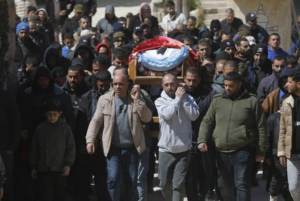
Residents of Yatta, south of Hebron, mourn the death of 27-year-old Amir Shanaran who was killed by an Israeli settler, 8 March 2026
Qassam Muaddi writes in Mondoweiss on 11 March 2026:
Israel’s accelerating crackdown on the West Bank over the past two years has reached the point of feeling like the new normal. Palestinians say that the strangulation of their daily lives is here to stay, with many describing the regime of closures and land seizures as “irreversible.”
But this crackdown also runs contrary to the longstanding Israeli policy of avoiding “friction” in the West Bank to prevent an “explosion” among Palestinians in response to Israeli repression. This was the dominant approach of successive Israeli governments up until October 7, 2023.
In late February of this year, shortly before the beginning of Ramadan, the Israeli army and security branches warned the Israeli government of a possible escalation in Palestinian “violence” in the West Bank. The holy month has been known in the past to coincide with mounting political tensions due to the role the al-Aqsa Mosque in galvanizing protests around the right of Palestinians to pray freely at the holy site. Israel historically attempted to maintain calm during these months by allowing Palestinians from the West Bank to obtain permits to visit al-Aqsa.
But this year, Israel broke with convention, using only 10,000 permits for Palestinians to visit during Ramadan, a historic low made worse by the restriction of the permits to children under 12, men over 55, and women over 50. Then, once the U.S.-Israeli war on Iran started, Israel revoked all Ramadan-related permits.
These measures come after Israeli settlers stormed the al-Aqsa compound 24 times during February alone, with thousands of Israelis taking part in Jewish religious rituals in violation of the accepted status quo at the site.
This all represents a sharp escalation, given that similar provocations at al-Aqsa in Ramadan have elicited widespread protests across Jerusalem and the West Bank in the past. The most notable example was the 2021 “Unity Intifada” that broke out in response to settler provocations at al-Aqsa and the threat of displacing residents of the Sheikh Jarrah neighborhood.
It is as if the Israeli government is deliberately trying to provoke an eruption in the West Bank, running contrary to all warnings from the Israeli security establishment of an imminent “security escalation.” But why would Israel want such a conflagration?