

Where are the Israeli Jews? The lonely protest of Arab citizens against a horrific murder rate
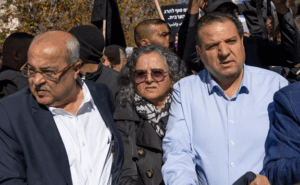
Arab MKs Ahmad Tibi, Aida Touma-Sliman and Ayman Odeh at the protest against Arab deaths, 11 January 2026
Dahlia Scheindlin writes in Haaretz on 13 January 2026:
As of January 11, 14 Arab Palestinian citizens had been murdered in Israel since the new year; two were killed by Israeli security forces; the rest were the victims of crime. Arabs in Israel are beside themselves with grief, anger, and a sense of abandonment. On Sunday, Arab community leaders called for a demonstration outside the Prime Minister Benjamin Netanyahu’s office in Jerusalem.
On a brilliant January day, the modest crowd was simultaneously depressed, animated and determined, marching between police barriers on a small strip of the road for about two hours. Top Arab political leaders, women activists from the north, representatives of Bedouin communities in the Negev, elderly men and clusters of young people chanted slogans calling for life and peace and expressing fury at the current government.
Arab teens in burgundy sweatshirts with the logos of AJEEC NISPED, the Jewish-Arab Negev coexistence organization, gathered after the demonstration as Arab and Jewish co-directors, Sliman Al-Amour and Ilan Amit, gave inspiring speeches about the importance of their activism. Tears glinted off their cheeks in the sun, as they recalled 16-year-old Azmi Gharib – a friend and fellow activist, said organizers – who was shot and killed the previous day in Nazareth.
But Arabs in Israel have poured out their anguish too many times to count in recent years. In 2020, Arab women marched from Haifa to Jerusalem; at a march and demonstration in August 2023, I even gave a brief speech about Arab-Jewish solidarity on the issue.
Nothing has worked. In the first year of the current government, the number of Arab victims more than doubled, from 116 in 2022 to 245 in 2023. The first 11 days of 2026 saw Arab citizens murdered at approximately twice the rate of 2025, which was already at a peak – roughly one every day and a half. In 2025, the civil society group Abraham Initiatives reported 252 Arab victims, out of a total of 305 murder victims in Israel, according to the Israel Police.
Although the police data showed that 78 percent of the victims were Arab (while citing a lower absolute number), the spokesperson also reported to Haaretz that fewer than half of all indictments were opened in those cases (30, compared to 32 for the murder of Jews).
It’s true that demonstrations have hardly “worked” at all against this government on any issue. Nevertheless, something huge is missing in the public outcry against crime in the Arab community: a serious and mainstream presence of Israeli Jews.
Where are the protest leaders and politicians?
First, it is critical to recognize the stalwart support of Jewish partners who did show up. The extraordinary Jewish-Arab civil society group Standing Together works tirelessly to mobilize around the issue; as always, its leaders and activists were marching on Sunday, their trademark purple signs scattered throughout the crowd. AJEEC brought Arab youth and some Jewish activists to the event. A few other Jewish demonstrators hoisted posters signed discreetly by “the Socialist Struggle.”
But despite these deeply valuable efforts, the demonstrators, as usual, appeared to be at least 90 percent Arab, while Jewish supporters were limited to the tiniest far-left corners of society. In this light, the somber tone of Israeli news reporting on Arab crime sounds increasingly artificial, or worse – an implicit reinforcement of Jewish stereotypes about violent Arab society.
Where is the hyper-mobilized anti-government protest movement? This extraordinary citizen groundswell turned out unflaggingly for the three most terrible years in Israeli history, before and during the war. Now, nearly all the hostages are home, and no one is demonstrating for a real cease-fire in Gaza. Surely these masses now have the capacity to join another life-or-death struggle, another symptom of corruption and failure of the government they despise.
The protest’s top leaders, such as the physicist Shikma Bressler, the charismatic activist Moshe Radman, and the high-tech entrepreneur Ami Dror, have become national celebrities. Their presence at the demonstration would be a huge story.
Moreover, Radman and Dror are both newly-minted political figures, after formally joining Yair Golan’s party, The Democrats, last week. Joining the fight against crime in the Arab community would therefore go beyond a social statement; it would represent a new political vision for a mainstream Zionist party.
Where are the party leaders themselves? Yair Golan advocates political partnership with Arab parties for future coalition building, but he wasn’t there on Sunday. Nor was Gadi Eisenkot, Israel’s up-and-coming centrist anti-Netanyahu hope, who has also advocated for using Arab parties to oust the current government. Do either have a vision of real partnership, mutual commitment to one another’s well-being, as equal citizens – or do their dreams stop at political expediency?
Their absence is not only cold-hearted, it’s bad strategy. Golan thinks the opposition parties will win an anti-Netanyahu majority in the next elections if Arab parties get the ten seats predicted by most polls. But nothing should be taken for granted. These days, Arab voters struggle profoundly over whether they should vote at all and their turnout can plunge, usually after deep injury to the community, such as the police killing of 13 Arabs in Israel in the year 2000, or the passage of the Nation-State Law favoring Jews, in 2018.
It turns out that for Arab voters, being treated like props for the opposition parties on election day, with their existential concerns discarded before and after that moment, is demotivating. In a telling moment, Ismahan, a mother and an activist from Haifa at the demonstration, pleaded for Jewish Israelis to be more involved. But when asked if the “change government” – the common term among Israelis for the government led by Naftali Bennett from 2021 to 2022 – had improved the situation, she asked, not rhetorically: “What is the ‘change government?”
A fresh gesture of support by a leading Israeli Jewish politician could inject real enthusiasm.
Even strategically, there is zero risk. Golan or Eisenkot can’t be branded on this issue as leftists, Palestinian-lovers, or terror supporters by the toxic current government, which itself promised to bring back “governance” among Arab communities and failed like it has at everything else. For opposition politicians, frankly, this fight should be a no-brainer.
And the list of mainstream and Jewish Israeli activists who should be involved goes on. The number of women murdered has doubled from 2022 to 2025 (23 and 46 according to the Knesset Research and Information Center and Haaretz). According to the Abraham Initiatives, in 2025, half were Arab, and so half were presumably Jewish. Where was the Israel Women’s Network, or any other feminist leaders and organizations at the demonstration?
Again, demonstrations will not change the policies of this Jewish supremacist prime minister or government. But the long-term social and political ripples can spread far into the future.
Partnership requires both sides
As much as Jewish society is needed, the Arab community in Israel faces serious questions about how to address crime at the political level. The issue is practically a microcosm of Arab political dilemmas in Israel.
Hadash party leader Ayman Odeh has called for mass civil disobedience to address the issue. That’s because Hadash and its closest political allies, Ta’al and Balad, are unlikely to join a future coalition; they seek to advance the struggle from the opposition.
By contrast, Mansour Abbas, leader of the United Arab List, broke the longstanding Israeli political-psychological barrier in 2021 by bringing his party into the “change” coalition that year. On Sunday, he told Haaretz “if I can point to one serious thing the previous government did, we managed to turn the trend around, from a consistent rise [in murders] to a decline for the first time.”
Indeed, the Knesset Research and Information Center documented 178 murders in Israel 2021, and 143 the next year, which was the only full year under that government. The Abraham Initiatives found that 126 Arabs were murdered in 2021, declining to 116 in 2022.
But even Abbas was skittish when asked if his party should take a ministerial portfolio responsible for these issues. In the minefield of Arab politics in Israel, taking on an executive role goes beyond just joining the coalition, sensitive for both Jews and Arabs. Abbas first deflected the question, then, when pressed, he said “I don’t think this is the aim right now, we’ll see what develops.”
But ultimately, it’s the Jewish and Zionist parties who will lead this country in the future. It’s their responsibility to prove that their aims go beyond political exploitation. True partnership will make it that much easier to get the political support they crave; it will also save lives.
This article is reproduced in its entirety